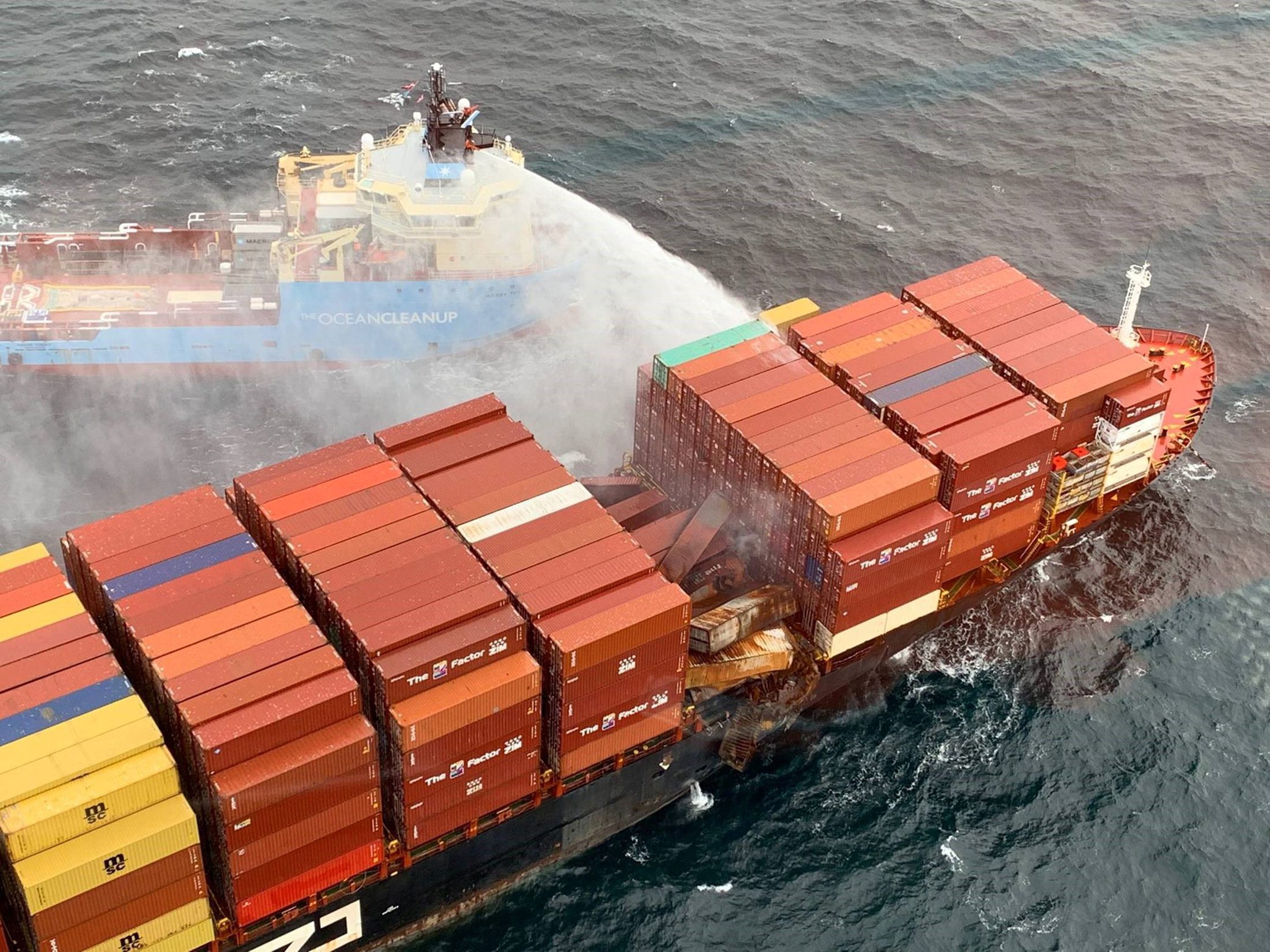
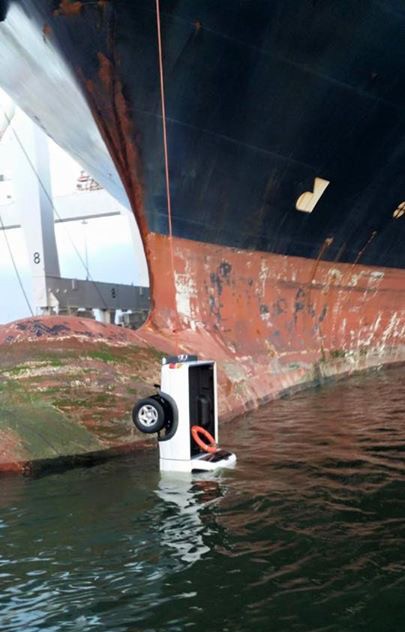
Today’s Incident Photo Of The Week is the tugboat “The Carrie”. News 6 in Corpus Christi tells us:
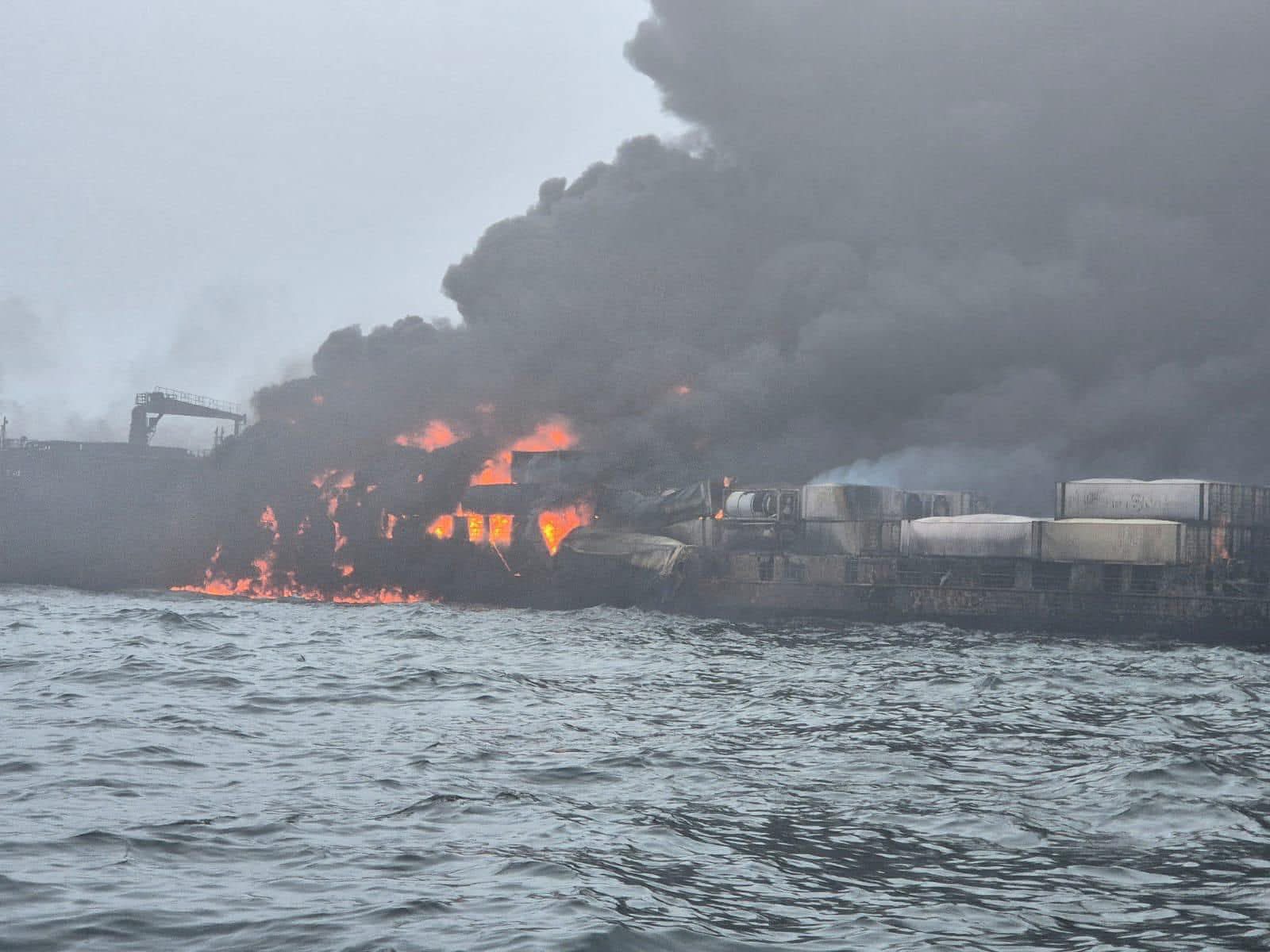
A tugboat caught fire at about 7 a.m. Tuesday after pushing a barge from Ingleside to Rincon Channel to offload some diesel fuel and brine water.
Port of Corpus Christi Assistant Chief Tom Mylett said that when it came into the channel, the captain of “The Carrie” discovered a flash fire in the engine room.
The barge’s contents were the biggest concern.
“It was 500 gallons of diesel fuel, from what we understand, that was on the barge, that was set for delivery inside Rincon. Then, there were several other drums you have on your footage of brine water; nonflammable material,” Mylett said.
There was also an additional 500 gallons of fuel on the tugboat.
Luckily no one was injured. Click HERE for the full story and HERE for the video. (via Maritime Monday 129)
Tags: · fire, Fire Incidents, incident, incident photos, tugboat
Reuters tells us:
Sep 18 - A fire on a Russian warship in the Pacific kills two sailors, the latest in a series of accidents that have raised doubts about the safety of Russia’s fleet. The fire occurred on the large anti-submarine ship the Marshal Shaposhnikov. Navy officials said they suspected the fire broke out in the engine room when an oil pipe ruptured during a naval exercise in the Sea of Japan.
This is undoubtely an embarissing incident for the Russian Navy as it gears up for a show of force in America’s backyard. Is the Monroe doctrine still in effect? We are not so sure considering the Roosevelt Coorelerary was based, in part, on the idea to “Speak softly and carry a big stick”! An idea that today’s politicians seem to have forgotten.
Either way, wth Russia increasing military spending by over 25%, China building Ballistic Missile Submarines and the US Navy’s inability to defend their own most valuable assets, the waters may soon be less safe for the average mariner.
Tags: · fire, incident, Navy, russia
Youtube user annanoli tells us:
Italian liner Principessa Jolanda sinks during launch because of defective ballasting and errors in calculations. Moreover many portholes were left open, and a donkey boiler exploded for the flood. The sistership Principessa Mafalda was launched two years later after extensive reduction in height. She was lost in 1927 for she lost tailshaft in mid-ocean and successive flood could not be stopped.
The wreckage of Jolanda was scrapped,engines salvaged were reutilized.
If any gCaptain readers have more information on this incident then please leave a comment below.
Tags: · boat_launching, incident, ship_sinking, Video
Pilotage Paradox
by Paul Drouin
The Cosco Busan accident, as with many others that have the same root cause, can be categorized into what I call the pilotage paradox. For on the one hand, we wish to confide the safety and con of the vessel to the pilot, yet on the other insist it is the crew and captain that are ultimately responsible and accountable for the safe conduct of the vessel.
In the seven minute interval between leaving the inner harbour and striking the bridge pylon, the pilot gave 13 helm orders without the slightest indication on the bridge of the Cosco Busan that anything was amiss. We know this because the National Transportation Safety Board (NTSB) has left an amazing amount of information on their public docket website, including transcripts of the bridge voice recordings.
Leaving berth 56 (Port of Oakland) and passing under the San Francisco-Oakland Bay Bridge is a relatively simple matter, even under blind pilotage conditions, as only two course changes bring you through the span. The Delta-Echo span of the bridge is wide, with a horizontal clearance of 673 meters, and is equipped with a RACON dead center of the span. For the Cosco Busan, winds were light and the vessel would be stemming the flood current as it passed under the bridge. This maneuver should not give an experienced 3rd Mate cause to sweat, much less an experienced pilot.
Under keel clearance was not great for the Cosco Busan, however, and as a consequence hydrodynamic forces on the hull caused by the flood tide would have been strong as the vessel’s sidebody came to obstruct the flow, which was setting at approximately 130° (T) near the bridge and anywhere up to 168° (T) further from the bridge. [Continue Reading →]
Tags: · accident, allision, bay bridge, cosco-busan, cosco_busan, disaster, incident, maritime pilots, maritime safety, ntsb, oil, safety, San Francisco, san franscisco bay

Crushed containers hang off the the vessel

More hang off the stern including one self-unloading box
While crossing the Pacific in late February 2008, M/V CMA CGM Dahlia ran into a strong storm, suffering significant damage. The vessel makes it to the Port of Manzanillo, Mexico where Emergency Services stand by to assess the damage. Containers hang off the starboard side since the storm hit, with more damaged on the stern.
This along with other maritime disasters can be found at cargolaw.com
Tags: · containers, damage, incident, Photo

March 21, 2006 - M/V Hyundai Fortune suffered a major explosion about 43 miles off the coast of Yemen in the Gulf of Aden. An estimated 60 - 90 containers were blown overboard forming a debris field about 5 miles in diameter around the vessel. Fortunately, a destroyer from the Netherlands was nearby to provide assistance. All 27 of the crew were rescued, with just 1 receiving non-life threatening injuries.

The cause of the fire is not known but according to cargolaw:
“Photo analysis shows what appears to be a significant section of hull plating blown out above the waterline on the port side, under the house and aft deck (pictured above). If this is accurate, might have been an explosion inside a tank, as opposed to an explosion in a container.”
For more information on this and other maritime disasters, visit cargolaw.com
Even more information on the incident can be found HERE
Tags: · explosion, Fire Incidents, incident, Photo

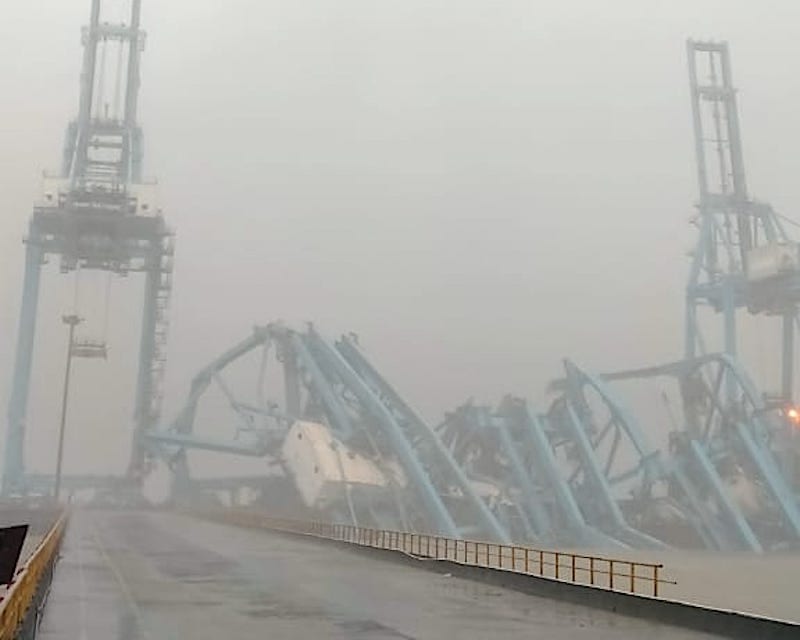
August 13, 2008: From what appears to be the result of strong winds whipping through the area, a 125 ft., 950-ton container crane collapsed, slamming into a second crane of the same size. Both cranes crumbled to the ground in a heap of twisted metal, damaging a third crane.
The cranes, located on Jaxport’s Blount Island Marine Terminal in Jacksonville Fl., cost an estimated $6M each. Luckily, no injuries were reported.
Investigators are looking further into the incident, as the cranes have withstood tropical storms for 25 years without a hitch.
For more information on this and other maritime incidents, check out Cargolaw.
Tags: · collapse, crane, incident, jaxport, wind


December 10, 2007 - Upon departure from Montevideo on The Rio de la Plata, the M/V Norwegian Dream fully loaded with passengers on a 23 day cruise, collided with an adrift container barge. Despite valiant efforts the collision could not be avoided.
Both vessels suffered severe damage. The barge lost multiple autos and containers overboard with loss and damage estimated in the millions. The M/V Norwegian Dream suffered a four-by-four foot hole in the bow about five feet above the water line, and was quickly returned to Montevideo for repairs.
As for the passengers, they were offered some compensation for the mishap but continued on after the repairs were made.
More information on this incident can be found at CargoLaw.
Another interesting note… The Norwegian Dream is now a two-time Incident Photo of The Week’er. Check out the first incident HERE.
Tags: · barge, collision, cruise_ship, incident
Like one of those awkward moments you get when rushing on a busy sidewalk, M/V Grande Nigeria and M/V Nada V just couldn’t seem to pick sides and suffered a head on collision.

More information and photos of this incident can be found at CargoLaw.
Tags: · cargo_law, collision, crash, incident, Photo

In tribute to The Discovery Channel’s Shark Week that is currently in full swing, we bring to you the sinking of the USS Indianapolis CA-35, resulting in what is considered by many the worst shark attack of all time.
In the early morning hours of July 30, 1945, the USS Indianapolis, just 4 days after it delivered the first combat-ready atomic bomb to the US air base at Tinian Island in the Pacific, was fatally struck by torpedoes from Japanese subs. Within minutes, some 900 of the 1,196 men on board were in the shark infested waters, equipped only with life jackets. Few life rafts were deployed.
The shark attacks began with the rising sun that morning and continued until the remaining men were rescued just over 4 days later. Of the initial 900 or so men that went into the water, only 317 survived, making it the worst maritime disaster in U.S. Navy history.
We all remember the scene in Steven Spielberg’s 1975 thriller ‘Jaws’ where Quint, the shark fisherman, is describing the horrible scenes that took place during the 4 days in the water. With that in mind, here is a first hand account from survivor Woody Eugene James:
Day 1
The next morning we kind of counted heads the best we could. There was about 150 people in the group. We were scattered around quite a bit. Well this isn’t too bad, we thought, we’ll be picked up today. They knew we were out here after all we were due in the Philippines this morning at 11:00 so when we don’t show they’ll know. If they didn’t get a message off, but we’re sure they got a message off, they’ll still know where we are so no sweat, we’ll be picked up before the days over.
So the day passed, night came and it was cold. IT WAS COLD. The next mornin the sun come up and warmed things up and then it got unbearably hot so you start praying for the sun to go down so you can cool off again.
Day 2
When the sharks showed up, in fact they showed up the afternoon before but I don’t know of anybody being bit. Maybe one on the second day but we just know we’ll be picked up today. They’ve got it all organized by now, they’ll be out here pretty soon and get us, we all thought. The day wore on and the sharks were around. Come night time and nobody showed up. We had another night of cold, prayin for the sun to come up. What a long night.
Day 3
The sun finally did rise and it got warmed up again. Some of the guys been drinkin salt water by now, and they were goin bezerk. They’d tell you big stories about the Indianapolis is not sunk, its’ just right there under the surface. I was just down there and had a drink of water out of the drinkin fountain and the Geedunk is still open. The geedunk bein the commissary where you buy ice cream, cigarettes, candy, what have you, “it’s still open” they’d tell ya. “Come on we’ll go get a drink of water”, and then 3 or 4 guys would believe this story and go with them.
The day wore on and the sharks were around, hundreds of them. You’d hear guys scream, especially late in the afternoon. Seemed like the sharks were the worst late in the afternoon than they were during the day. Then they fed at night too. Everything would be quiet and then you’d hear somebody scream and you knew a shark had got him.
It didn’t ever get any cooler in the daytime. In fact, Newhall asked me, he said, “James, do you think it’s’ any hotter in hell than it is here?” I said, “I don’t know, Jim, but if it is, I ain’t goin.”
We were hungry, thirsty, no water, no food, no sleep, getting dehydrated, water logged and more of the guys were goin bezerk. There was fights goin on so Jim and I decided to heck with this, we’ll get away from this bunch before we get hurt. So he and I kind of drifted off by ourselves. We tied our life jackets together so we’d stay together. Jim was in pretty good shape to begin with, but he was burned like crazy. His hand was burned, he couldn’t hold on to anything, couldn’t touch anything.
Day 4
Then the next day arrived. By this time I would have give my front seat in heaven and walked the rotten log all the way through hell for just one cool drink of water. My mouth was so dry it was like cotton. How I got up enough nerve to take a mouth full of salt water and rinse my mouth out and spit it out I don’t know but I did. Did it a couple of times before the mornin was over. That’s probably why I ended up with salt-water ulcers in my throat. When we got picked up my throat was bigger than my head.
Anyway, we’re out there in the sun prayin for it to go down again, then low and behold there’s a plane. Course there had been planes everyday since day one. They were real high and some of the floaters had mirrors that tried to attract them, but nothing. Anyway, this one showed up and flew by and we thought, “Oh hell, he didn’t see us either. He’s gone.” Then we seen him turn and come back and we knew we had been spotted. What a relief that was.
So he did, he came back and flew over us. It was a little PV1 Ventura. It was out on submarine patrol and he spotted us. He radioed back to his base and instead of sending some help out, the Navy sent one plane out. One PBY that came out and circled and radioed back to the base that there was a bunch of people in the water and he needed more assistance and more survival gear. The pilot ended up landin in the water and picked up a lot of guys, the single guys, one or two guys that were together so the afternoon went on. Late in the afternoon before dark there was another PBY on the scene. He dropped his survival gear and he dropped a little three-man rubber raft. Jim and I tried to swim to it. He made it but I didn’t. I was just so wore out from holding him up and hangin on to him all day and the night before, I just couldn’t make it but he did. About the time he got on it there was two other guys so there is three of them total in it and that’s all it was made for, three.
Anyway, the other direction there was two guys in the water and the two guys in the raft told Jim, “we’ll go over there and pick those two up”. Jim said, “No, we’re goin go pick Woody up then we’ll go get those two guys.” They said “Nope, we’re goin to do it the other way.” The raft contained those little aluminum oars that come in two pieces and Jim put one of them together and threw the other one over board. “Okay you guys, I don’t want to be mean but we’re goin over to get Woody and you guys are goin to do the paddling by hand. If you don’t things, are goin to happen with this oar that you ain’t agoin to like.” So they came over and picked me up and that’s how I owe Jim Newhall my life. If it had not been for that I wouldn’t be here tellin this story.
So they picked me up, then we went and got the other two guys. Now there’s six of us on this raft. It’s getting pretty crowded but we run onto three other guys and we picked them up. Now there’s nine of us on this little raft. It’s just about dark and figure we’ll make it through the night one way or another. About midnight, a little bit before there was a light shining off of the bottom of the cloud and we knew then we were saved. That was the spotlight of the Cecil Doyle. The Navy is on the scene. There’s a ship comin. You can’t believe how happy we were, guys screamin and yellin, “We’re saved, We’re saved.”
Morning of the 5th Day
The Doyle arrived on the scene and started pickin survivors out of the water a little after midnight. It was daylight the next morning that he came along side us in our little raft. Boy, what a happy day that was to get my feet on the deck again.
For the rest of this story and other interesting facts about the USS Indianapolis CA-35, check out the official website HERE.
Great oral recollections of the events from Commanding Officer ,Captain Charles B. McVay, III and Senior Medical Officer, Captain Lewis L. Haynes can be found HERE and HERE
Also check out information on Discovery Channel’s Shark Week HERE
Tags: · incident, Navy, Sharks, USS Indianapolis