The Maeslant Storm Surge Barrier is one of the largest moving structures on the planet. The barrier, completed in May of 1997, was the final stage of the Delta Works, a series of dams, sluices and storm surge barriers aimed to protect the port of Rotterdam and surrounding communities from flooding. The Delta Works was originally started following the North Sea flood of 1953 that killed over 1,800 people.
The barrier consists of two large steel gates that operate on ball-and-socket joints, much like the human shoulder, that move freely with rising water, wind and waves. The gates then close automatically by a computer system that makes the decision based on water levels and weather forecasts, with no human interaction needed.
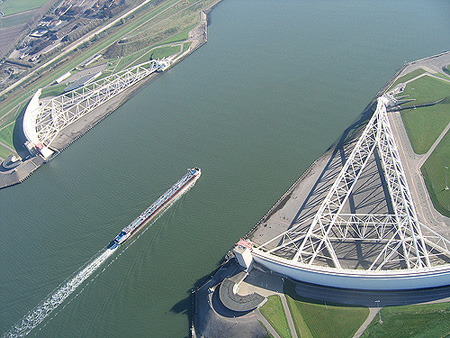
During water levels of 3 metres above Amsterdam ordnance zero, the arms of the barrier are activated. The waterway, with a width of 360 metres, can then be closed completely. At first sight, it is almost unbelievable that such a barrier is capable of such an achievement. The Maeslant barrier is almost as long as the Eiffel tower and weighs about four times as much. It is the only storm surge barrier in the world with such large moveable parts. The storm surging doors have a length of 240 metres each. Under normal circumstances, these doors are fully opened, so that the ships have access to the port of Rotterdam. The doors are stored in docks with a length of 210 metres, which lie along both shores.
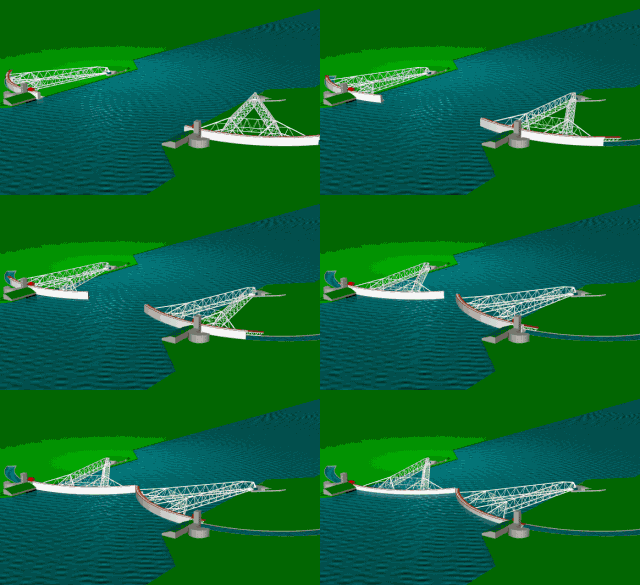
During storm tide the docks are flooded and the hollow doors begin to float. They are driven into the water by means of a small train. This lasts for about half an hour. When the doors are situated in the middle of the river, valves are opened and as a result the doors are flooded. Consequently, the doors sink to the bottom because of their weight. On the bottom, there is a concrete threshold. A lot of silt gathers on this threshold. To close the New Waterway properly, arms need to be positioned exactly on the threshold. The doors do not sit directly on the threshold yet, but are hung a little above them. The current under the doors becomes so strong that the silt is washed away. After about an hour, the doors can sit flat on a silt-free threshold. The water level on the seaside is then higher than the water on the riverside. The force against the surging wall during a storm is about 350 Mega Newton: this is equal to the weight of 350,000 strong men, carrying 100 kilograms each. The pressure difference is so large that a ship of equal measurements would capsize instantly. The unique shape of the barrier prevents this from happening.
Since its completion, the Maeslant barrier has been closed once from a strong storm in November of 2007. However, with rising sea levels, the Dutch Government expects the gates to be used more often.
The 2024 Atlantic hurricane season is expected to be exceptionally active, according to researchers at Colorado State University. In their initial forecast, they predict 11 hurricanes, marking the highest prediction...
by Murray Scown, Lund University and Frances Eleanor Dunn, Utrecht University (TheConversation) Perilously situated between rising sea levels and pressures from upstream lie coastal river deltas and their roughly half...
A Hurricane Warning remains in effect for the Atlantic High Seas associated with Hurricane Lee with peak seas of around 47 feet near the center as the system moves slowly...
September 14, 2023
Total Views: 4080
Why Join the gCaptain Club?
Access exclusive insights, engage in vibrant discussions, and gain perspectives from our CEO.
This website uses cookies to improve your experience while you navigate through the website. Out of these, the cookies that are categorized as necessary are stored on your browser as they are essential for the working of basic functionalities of the website. We also use third-party cookies that help us analyze and understand how you use this website. These cookies will be stored in your browser only with your consent. You also have the option to opt-out of these cookies. But opting out of some of these cookies may affect your browsing experience.
Necessary cookies are absolutely essential for the website to function properly. This category only includes cookies that ensures basic functionalities and security features of the website. These cookies do not store any personal information.
Any cookies that may not be particularly necessary for the website to function and is used specifically to collect user personal data via analytics, ads, other embedded contents are termed as non-necessary cookies. It is mandatory to procure user consent prior to running these cookies on your website.

 Join The Club




 During storm tide the docks are flooded and the hollow doors begin to float. They are driven into the water by means of a small train. This lasts for about half an hour. When the doors are situated in the middle of the river, valves are opened and as a result the doors are flooded. Consequently, the doors sink to the bottom because of their weight. On the bottom, there is a concrete threshold. A lot of silt gathers on this threshold. To close the New Waterway properly, arms need to be positioned exactly on the threshold. The doors do not sit directly on the threshold yet, but are hung a little above them. The current under the doors becomes so strong that the silt is washed away. After about an hour, the doors can sit flat on a silt-free threshold. The water level on the seaside is then higher than the water on the riverside. The force against the surging wall during a storm is about 350 Mega Newton: this is equal to the weight of 350,000 strong men, carrying 100 kilograms each. The pressure difference is so large that a ship of equal measurements would capsize instantly. The unique shape of the barrier prevents this from happening.