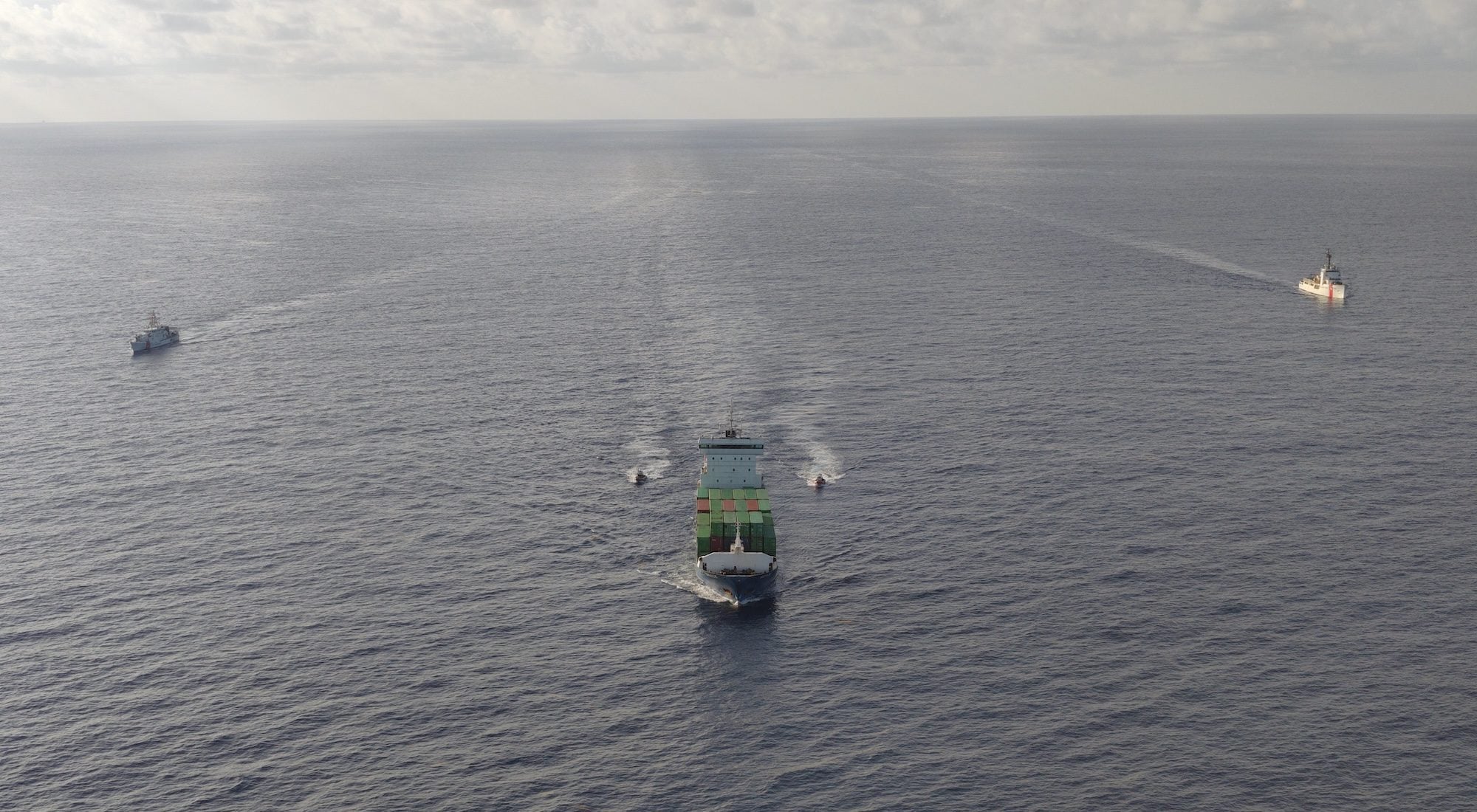
A Coast Guard Station San Juan boat crew, working with Homeland Security Task Force – San Juan Region partner agencies, interdicted a drug-smuggling vessel in the Atlantic Ocean north of Puerto Rico on January 14, seizing 16 bales of cocaine valued at more than $7 million and arresting three suspects.
The operation began when a Coast Guard Air Station Miami HC-144 Ocean Sentry aircraft detected a suspicious 25-foot panga-style go-fast boat in international waters north of Vega Baja. Sector San Juan watchstanders vectored the cutter Joseph Tezanos and a 45-foot Response Boat–Medium crew to intercept, while a Customs and Border Protection Air and Marine aircraft maintained continuous aerial surveillance.
The Coast Guard crew successfully boarded and secured the vessel, detaining three men and recovering 506 kilograms (1,115 pounds) of cocaine. The suspects and contraband were later transferred to Homeland Security Task Force law enforcement partners in San Juan for prosecution.
“This interdiction highlights the strength of our interoperability and the effectiveness of our combined maritime enforcement posture,” said Cmdr. Matthew Romano, Coast Guard Sector San Juan’s chief of response, praising the coordination among Coast Guard, CBP, Department of Justice, and local law enforcement agencies.
The seizure was conducted under the Homeland Security Task Force initiative established by Executive Order 14519, aimed at dismantling transnational criminal organizations, drug cartels, and human smuggling networks operating in the Caribbean and across U.S. maritime approaches.
The interdiction comes amid what maritime security observers describe as the most aggressive U.S. counter-narcotics campaign in modern history.
Since September 2025, the Trump Administration has authorized U.S. military forces to use lethal force to disable and destroy suspected drug-smuggling vessels at sea, marking a sharp departure from traditional interdiction-and-arrest operations. Under expanded rules of engagement, U.S. forces operating in the Caribbean and Eastern Pacific have increasingly targeted go-fast boats and semi-submersible “narco-subs,” often under the operational control of U.S. Southern Command.
The strategy reframes maritime drug trafficking as a national security threat rather than a purely law enforcement challenge. Instead of focusing primarily on seizure totals, the campaign prioritizes systemic disruption — destroying vessels, eliminating trained crews, and degrading logistics networks to raise operational costs and increase deterrence.
Officials argue that sinking smuggling craft at sea prevents traffickers from reusing hulls and personnel while delivering a stronger deterrent effect than arrests alone.
For the maritime and shipping industries, the campaign represents a fundamental shift in U.S. maritime enforcement doctrine, with far-reaching implications for rules of engagement, international maritime law, regional security dynamics, and the expanding role of military forces in counter-narcotics operations.

 Join The Club