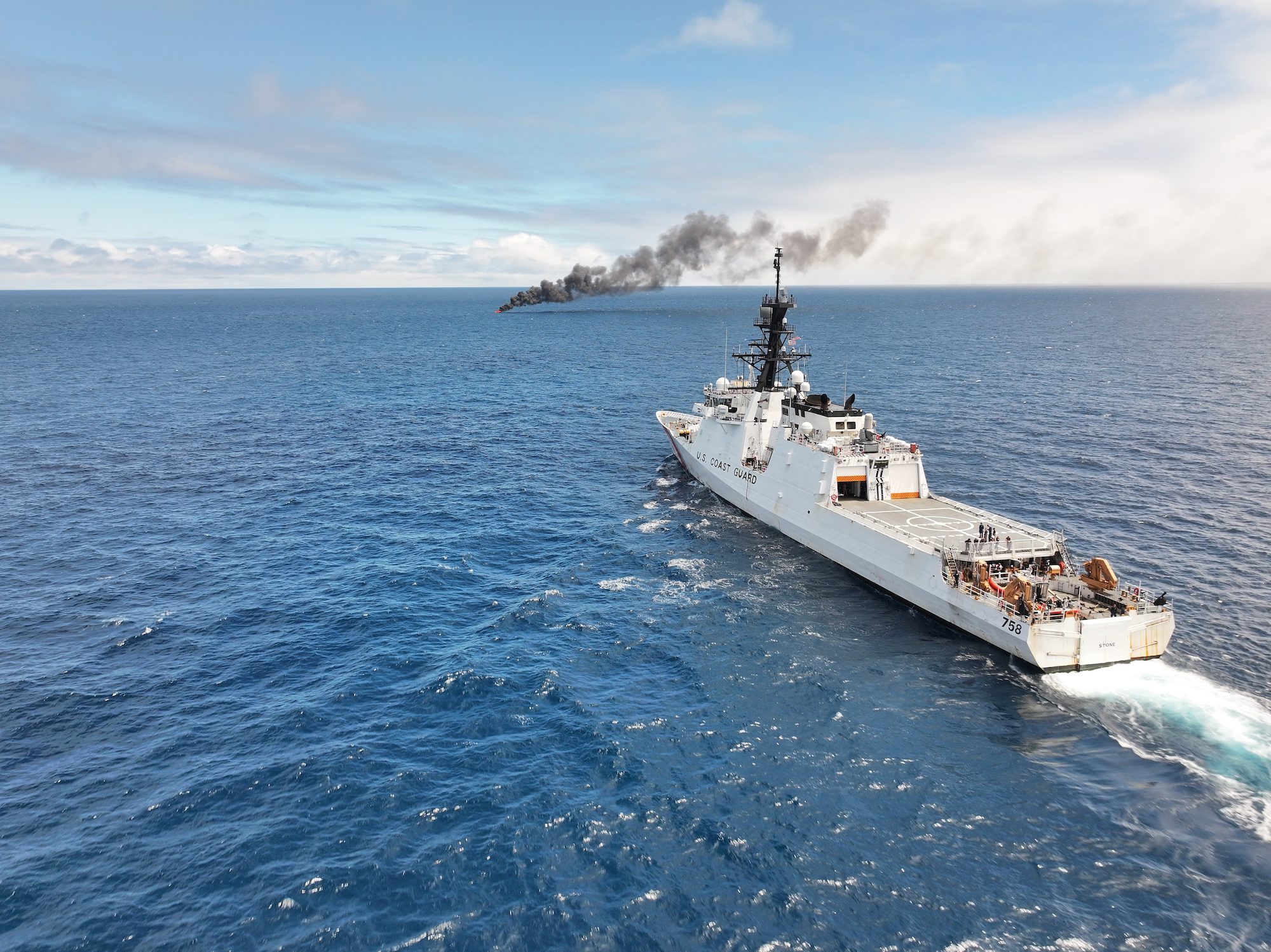
The U.S. Coast Guard announced Tuesday it has seized more than 150,000 pounds of cocaine in the Eastern Pacific Ocean since launching Operation Pacific Viper in early August, marking one of the most successful counter-narcotics campaigns in recent history.
The seizure represents over 57 million potentially lethal doses, based on the calculation that 1.2 grams of cocaine can kill a person. The interdictions have denied criminal organizations more than $1.1 billion in illicit revenue.
“Operation Pacific Viper has proven to be a crucial weapon in the fight against foreign drug traffickers and cartels in Latin America and has sent a clear message that we will disrupt, dismantle and destroy their deadly business exploits wherever we find them,” said U.S. Department of Homeland Security Secretary Kristi Noem.
The operation has produced several record-breaking interdictions. On December 2, Coast Guard Cutter Munro seized over 20,000 pounds of cocaine in a single interdiction after utilizing disabling fire on a heavily laden go-fast vessel—the Coast Guard’s largest at-sea interdiction since March 2007. The crew of Coast Guard Cutter James executed four significant seizures across 10 days in November, netting 19,819 pounds of cocaine.
Coast Guard Cutter Stone made history in November, offloading approximately 49,010 pounds of illicit narcotics worth over $362 million at Port Everglades—the largest single-patrol seizure by any Coast Guard cutter.
“This milestone is a testament to the vigilance and tenacity of our crews,” said Admiral Kevin Lunday, the Coast Guard’s acting commandant. “When we say we own the sea, it reflects our relentless pursuit to securing the maritime domain and disrupting the criminal networks that threaten our communities.”
The Coast Guard’s law enforcement approach stands in stark contrast to a parallel military campaign that has drawn intense criticism. Since September, President Trump’s Department of War has conducted at least 23 airstrikes against suspected drug-trafficking vessels in the Caribbean and Eastern Pacific, resulting in more than 87 deaths.
Secretary of War Pete Hegseth recently defended a controversial September 2 operation at the Reagan National Defense Forum, dismissing criticism over a second military strike on two survivors. “I fully support that strike. I would have made the same call myself,” he said.
Defense Department’s Law of War Manual forbids attacks on incapacitated or shipwrecked combatants who abstain from hostilities and don’t attempt escape. However, accounts of the attack have prompted concerns that U.S. forces may have carried out a war crime.
The dual campaigns highlight competing approaches to countering drug trafficking in the Western Hemisphere. While the Coast Guard continues traditional law enforcement interdictions with record-breaking success, the Department of War has pursued lethal military action that has drawn criticism from international human rights organizations, U.S. allies, and members of Congress.
Coast Guard interdictions in the Eastern Pacific are performed under the authority and control of the Coast Guard’s Southwest District, headquartered in Alameda, California. Detection and monitoring involves coordination through U.S. Southern Command’s Joint Interagency Task Force-South, based in Key West, Florida.
Approximately 80% of all U.S.-bound narcotics seizures occur at sea, highlighting the critical importance of maritime drug interdiction operations.

 Join The Club