On the evening of July 6, 1988, a gas leak ignited on the Piper Alpha platform in the North Sea. The explosion damaged the control room and destroyed power, alarm, and firewater systems. The platform’s emergency response plan quickly became irrelevant as the public address system failed and walls of flame blocked access to lifeboats. Dozens of crew members waited in accommodation modules for instructions that would never come.
Tharos, the emergency response vessel specifically designed to respond to such a disaster on the Piper Alpha within just 4 minutes, took 45 minutes to get its pumps up and running. Meanwhile, operators on nearby platforms continued pumping oil and gas to Piper Alpha for over an hour after the initial explosion because they were waiting for permission from an offshore emergency control center to shut down production.
By morning, 167 people were lost. Many of those who survived only did so because they took their lives into their own hands, jumping from heights of up to 174 feet into the water below.
The Piper Alpha disaster was the product of more than just a failure of equipment or procedures. It represented the wholesale collapse of offshore emergency response, spurring fundamental changes in how the industry prepares for, responds to, and recovers from emergencies at sea.
The Birth of Emergency Planning & Safety in Offshore Operations
Before the loss of Piper Alpha and most of her crew, comprehensive emergency planning in offshore operations was inconsistent at best. This started to change in 1990 with the release of The Public Inquiry into the Piper Alpha Disaster, which made 106 recommendations on emergency procedures, personnel training and information, and platform design improvements that would lay the foundation for modern offshore safety.
The UK’s Offshore Installations (Prevention of Fire and Explosion, and Emergency Response) Regulations 1995, commonly known as PFEER, furthered this progress. PFEER established goal-setting standards that required offshore operators to develop comprehensive emergency response plans based on risk assessments specific to each installation.
This marked a shift from prescriptive rules to performance-based goals for:
- Prevention, detection, control, and mitigation of fires and explosions
- Requirements for emergency response arrangements, including medical provision, evacuation procedures, and recovery and rescue operations
- Mandatory testing, monitoring, and reviewing of emergency response plans
The Deepwater Horizon Disaster & the Creation of the BSEE
Across the Atlantic, the United States would face its own watershed moment. On April 20, 2010, the Deepwater Horizon drilling rig exploded in the Gulf of Mexico while attempting to temporarily abandon the Macondo well in approximately 5,000 feet of water.
11 workers were killed. The rig burned for two days before sinking, leaving the well spewing oil and gas into Gulf waters for 87 days.
President Obama issued Executive Order 13543 in May 2010, creating the National Commission on the BP Deepwater Horizon Oil Spill and Offshore Drilling. The Commission’s January 2011 report revealed “such systematic failures in risk management that they place in doubt the safety culture of the entire industry.” Sweeping reforms, including the creation of an independent safety agency, were recommended.
The federal government responded by dismantling the Minerals Management Service, which had been responsible for both offshore safety regulation and resource development—an inherent conflict of interest. In October 2011, three new agencies emerged: the Bureau of Ocean Energy Management (BOEM), the Office of Natural Resources Revenue (ONRR), and the Bureau of Safety and Environmental Enforcement (BSEE). BSEE took sole responsibility for safety and environmental enforcement, with a clear mission focused on protecting offshore workers and the environment.
Sweeping Safety Requirements Enforced in the US
BSEE immediately began implementing new safety requirements. In October 2010, even before the formal reorganization was complete, the agency issued the Workplace Safety Rule, requiring all offshore operators to develop and maintain Safety and Environmental Management Systems (SEMS) programs. Based on the American Petroleum Institute’s Recommended Practice 75, SEMS requires a comprehensive, performance-based approach to managing offshore operations that goes far beyond simple compliance with standard regulations, much like PFEER in the UK.
The SEMS framework includes 17 elements addressing everything from hazard analysis and management of change to mechanical integrity, safe work practices, and emergency response and preparedness. Operators must conduct regular audits by accredited service providers, implement stop work authority that empowers any worker to halt unsafe operations, and maintain comprehensive training programs for all personnel, including contractors.
In 2016, BSEE finalized the Well Control Rule, implementing nearly 370 specific recommendations from multiple investigations into the Deepwater Horizon disaster. The rule established stricter requirements for blowout preventer design, testing, and maintenance, enhanced well design and casing standards, and mandated real-time monitoring of critical well parameters.
These reforms represented the most comprehensive overhaul of offshore safety regulation in U.S. history.
The Technology & Tools Behind Offshore Emergency Response
The evolution of offshore emergency response has also been shaped by technological advancements and tools, with everything from basic lifeboats to firefighting systems undergoing dramatic transformations over the past century.
Evacuation Systems: Beyond the Lifeboat
The 1912 sinking of the Titanic (which carried enough lifeboats for only 1,178 of the roughly 2,200 people on board) catalyzed the first major safety revolution at sea. The International Convention for the Safety of Life at Sea (SOLAS), established in 1914, laid the foundation for modern maritime safety regulations, including requirements that vessels carry sufficient lifeboats for all aboard.
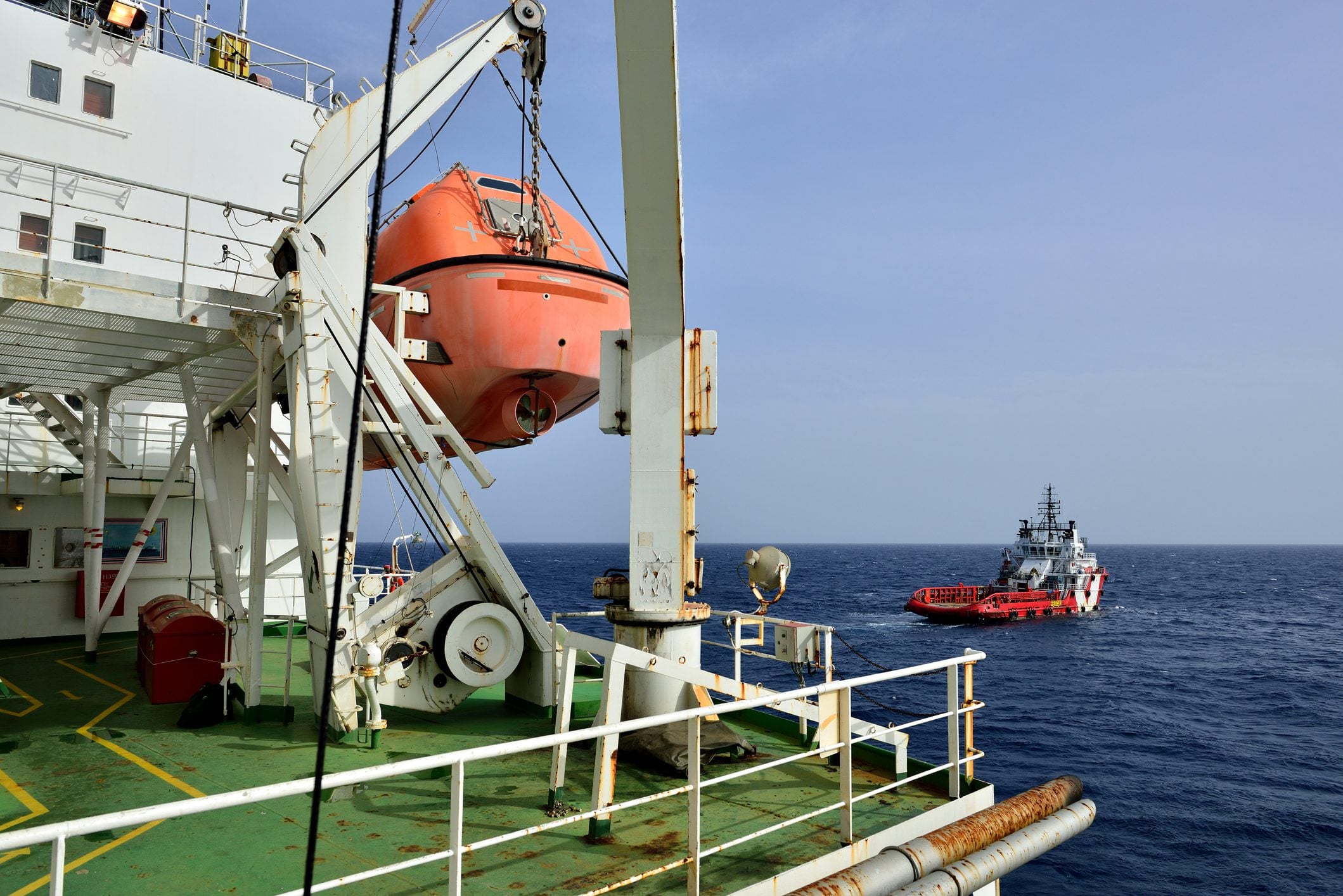
Modern offshore platforms must maintain evacuation capacities exceeding 110 percent of the maximum personnel on board. Today’s evacuation systems include multiple technologies designed for different emergency scenarios. Totally Enclosed Motor Propelled Survival Craft (TEMPSC), enclosed lifeboats that protect occupants from fire, toxic gases, and harsh weather, became mandatory on offshore platforms following a 1983 amendment to SOLAS. Each of these vessels can evacuate 50 to 150 people and is equipped with survival supplies, emergency beacons, and propulsion systems.
For rapid mass evacuations, Marine Evacuation Systems (MES) use chutes to slide personnel into life rafts below, evacuating people quickly when lifeboats cannot be safely deployed. Free-fall lifeboats, launched by sliding down ramps at angles up to 35 degrees, use kinetic energy to move away from the vessel, a critical advantage in emergencies involving fires or explosions. The latest generation includes all-electric models with improved reliability, performance, and zero diesel fuel storage requirements.
Advancements in Firefighting Technology
Offshore platforms continuously handle flammable materials, making fire suppression systems essential. Early offshore firefighting relied on basic water deluge systems and foam monitors. Following Piper Alpha and the failure of emergency response vessel Tharos to effectively fight the fire, the industry accelerated the development of more sophisticated systems.
Modern offshore fire protection combines passive and active systems. Passive systems include fire-resistant coatings and structural designs that slow fire spread and protect escape routes. Active systems have evolved significantly, with high-pressure water mist systems that use micro-droplets to suppress fire more effectively than traditional sprinklers while using minimal water. These systems can be activated immediately without waiting for personnel evacuation and don’t require air-tight spaces.
For electrical rooms and control centers where water could damage sensitive equipment, clean agent systems have largely replaced halon and CO2. Deck Integrated Fire Fighting Systems (DIFFS) feature flush-mounted nozzles that automatically telescope and spray foam or water when sensors detect flames, covering the entire helideck surface within seconds.
Advanced gas detection systems provide real-time monitoring of combustible and toxic gases, using infrared and ultraviolet sensors that can detect fires even in challenging offshore environments. These early warning systems give crews precious time to respond.
Medical Evacuation & the “Golden Hour”
The concept of the “golden hour,” the brief period after trauma when prompt treatment most improves survival, has impacted offshore medical response evolution. Helicopter medevac revolutionized battlefield medicine during the Korean War (1950-1953), reducing mortality rates among wounded soldiers. The offshore industry gradually adopted these lessons through the 1970s and 1980s.
Today, U.S. offshore installations maintain medical facilities staffed by trained paramedics, typically with helicopter medevac on standby. The U.S. Coast Guard plays the central coordinating role in offshore medical emergencies, often providing search and rescue helicopters when commercial operators cannot respond quickly enough. Modern protocols can mobilize nighttime evacuations within hours, with integrated medical teams handling critical emergencies while coordinating with shore-based hospitals.
However, the challenge persists. Many installations now operate so far from shore that they fall outside the golden hour window. This has driven the expansion of onboard medical capabilities and telemedicine, allowing remote consultation with specialists.
Real-Time Monitoring & Communication
Perhaps the most transformative technological advancement has been in detection and communication systems. Modern platforms employ networks of interconnected sensors and cameras that continuously monitor equipment condition and environmental factors. GPS-enabled Emergency Position-Indicating Radio Beacons (EPIRBs) transmit distress signals with exact coordinates to search and rescue authorities, drastically reducing response times. Electronic mustering systems have replaced manual roll calls, using wearable devices to track personnel location in real-time during emergencies. These systems provide accurate, immediate information about who has evacuated and who remains aboard—critical data for search and rescue teams.
The task is great. When Hurricane Ida struck the Gulf of Mexico in 2021, BSEE reported personnel evacuations from 279 production platforms (nearly 50 percent of manned platforms), an example of the scale at which these systems must function.
The Importance of Training, Culture & Worker Empowerment
Technology and regulations can only protect workers if the people operating offshore installations are properly trained and supported in prioritizing safety over production.
To this end, modern U.S. offshore operations emphasize comprehensive, scenario-based training. BSEE’s SEMS requirements mandate that all personnel, including contractors, receive training specific to their roles and the unique hazards of their platform. Regulations require “stop work authority,” empowering any worker to halt operations if they observe unsafe conditions.
Emergency response drills must be based on realistic scenarios and conducted periodically, with ongoing analyses to identify weaknesses. Personnel must understand not just procedures but the principles behind them, enabling adaptation when emergencies don’t match the script.
Looking Forward
Offshore emergency response continues to evolve. Artificial intelligence and machine learning are being deployed to predict equipment failures before they occur and analyze real-time sensor data to detect early warning signs of blowouts or structural failures. Autonomous systems, from drones to ROVs, are taking on increasingly complex roles, allowing humans to direct response efforts from safer distances. Virtual and augmented reality technologies are transforming training, allowing personnel to experience realistic emergency scenarios without the cost and risk of full-scale offshore drills.
Each major offshore disaster in the past century has revealed gaps in technology, training, regulation, or organizational culture. The question is whether the industry and its regulators will learn these lessons thoroughly enough to prevent the next catastrophe.
###
Arnold & Itkin is a maritime law firm that has been representing offshore workers since 2004. The firm’s trial attorneys have secured unmatched victories across their practice areas, setting and breaking records nationwide for the life-changing verdicts and settlements they’ve secured for their clients. The firm represented one-third of the Deepwater Horizon crew after the rig exploded in 2010, three widows of El Faro crew members who were lost when the vessel went down in Hurricane Joaquin in 2015, and countless others who needed help after the worst injuries and losses. The firm will continue to fight for what’s right. No matter what.

 Join The Club