The Norwegian Safety Investigation Authority (NSIA) released its report on the loss of propulsion and near-grounding of cruise ship Viking Sky on 23 March 2019. The incident “had the potential to develop into one of the worst disasters at sea” in recent times, the report highlights.
NSIA concludes that the vessel came within a ship’s length of running around with 1,374 passengers and crew aboard. Viking Sky would have run aground if propulsion had not been restored at the time it was. “This underlines the importance of not losing propulsion and steering,” the report cautions.
The vessel suffered a complete loss of propulsion for 39 minutes before the crew was able to restore power to move ahead at between 1 to 5 knots. The report identified insufficient lubrication oil in the sump tanks of all working diesel generators as the primary cause.
The design of the sump tanks did not comply with SOLAS regulations which, in combination with rolling and pitching of the vessel, contributed to a loss of lubricating oil pressure.
Simulation showing the suction pipe completely exposed to air during high roll and pitch angles. (Source: NSIA)
Operational, technical, and organizational deficiencies also played a role, e.g. the crew failed to transfer lube oil despite low oil level alarms going off prior to the incident.
In violation of the Safe Return to Port (SRtP) regulation the vessel departed from Tromsø two days prior to the accident with only three of its four diesel generators available.
“Viking Sky did not comply with the applicable safety standards, it should not have departed Tromsø under the prevailing circumstances,” the report warns.
In total NSIA issued 14 safety recommendations primarily focused on design and certification modifications of the sump tanks, including those on the Viking Sky’s seven sister ships.
It also recommends an improved sump tank lube oil level monitoring system, improved training, and operator friendly designs and alarms.
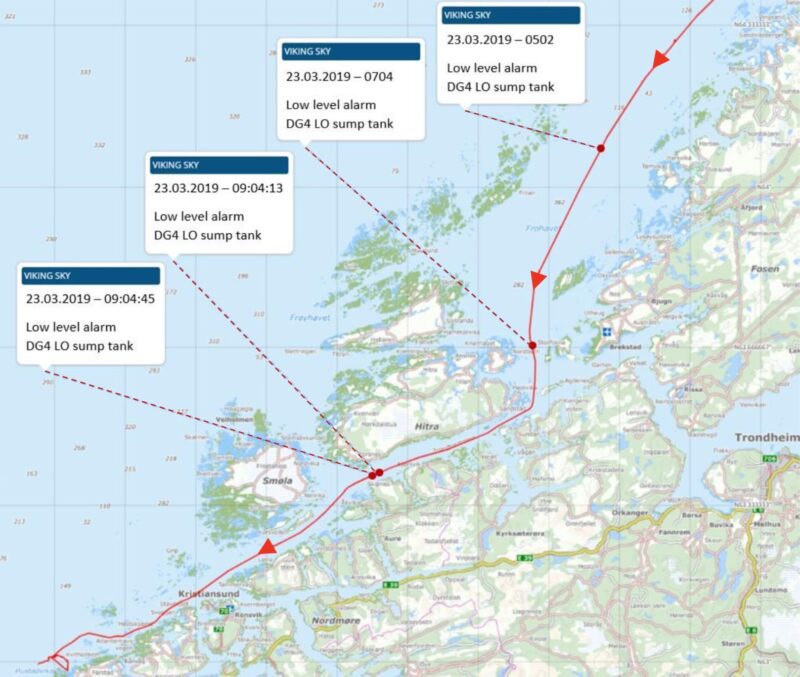
Prior to the loss of power the engine control room registered around 200 alarms in total, with 90 tank level warnings and four low lube oil alarms. The alarms were acknowledged but no remedial action was taken.
Subsequent alarms that oil levels had dropped below acceptable limits resulting in automatic load shedding were responded to in similar fashion.
Lube oil sump alarms in the time period from 0502 until 0904. (Source: NSIA)
NSIA points out that despite the extensive investigation “it has been difficult to understand why it took so long before filling of oil was started” and why it took 39 minutes for the crew to restore power and propulsion.
“It took 14 minutes from the blackout until refilling of the lube oil sump tanks was started, 10 more minutes to restart and connect the first diesel generator and another 15 minutes before both propulsion motors were operational and the ship had sufficient power available to maintain between 1 to 5 knots ahead,” the report details.
While the crew had conducted blackout drills, it had never trained the recovery from a full blackout without use of a standby generator.
A plethora of alarms in the engine room following the blackout further contributed to confusion and stress. The alarms also did not distinguish between low and high priority alerts.
“Troubleshooting was therefore challenging when a total of approximately 1,000 alarms sounded within the first 10 seconds after the blackout,” the report concludes.
By Daniel Katzive (gCaptain) – Unapproved use of a propane torch on deck triggered the explosion aboard a New York City municipal sludge tanker Hunts Point last May, according to...
A Houston ship pilot’s extended personal cell phone conversation and multiple failures to maintain a proper lookout led to the fatal 2024 collision between the bulk carrier Yangze 7 and the towing...
A routine maintenance job aboard the fishing vessel Antarctic Discovery turned into a dangerous toxic gas incident after decomposing fish waste was accidentally pumped into a machinery space, sending four workers to...
July 23, 2026
Total Views: 4183
Get The Industry’s Go-To News
Subscribe to gCaptain Daily and stay informed with the latest global maritime and offshore news
— just like 106,391 professionals
Secure Your Spot
on the gCaptain Crew
Stay informed with the latest maritime and offshore news, delivered daily straight to your inbox
— trusted by our 106,391 members
Your Gateway to the Maritime World!
Essential news coupled with the finest maritime content sourced from across the globe.

 Join The Club