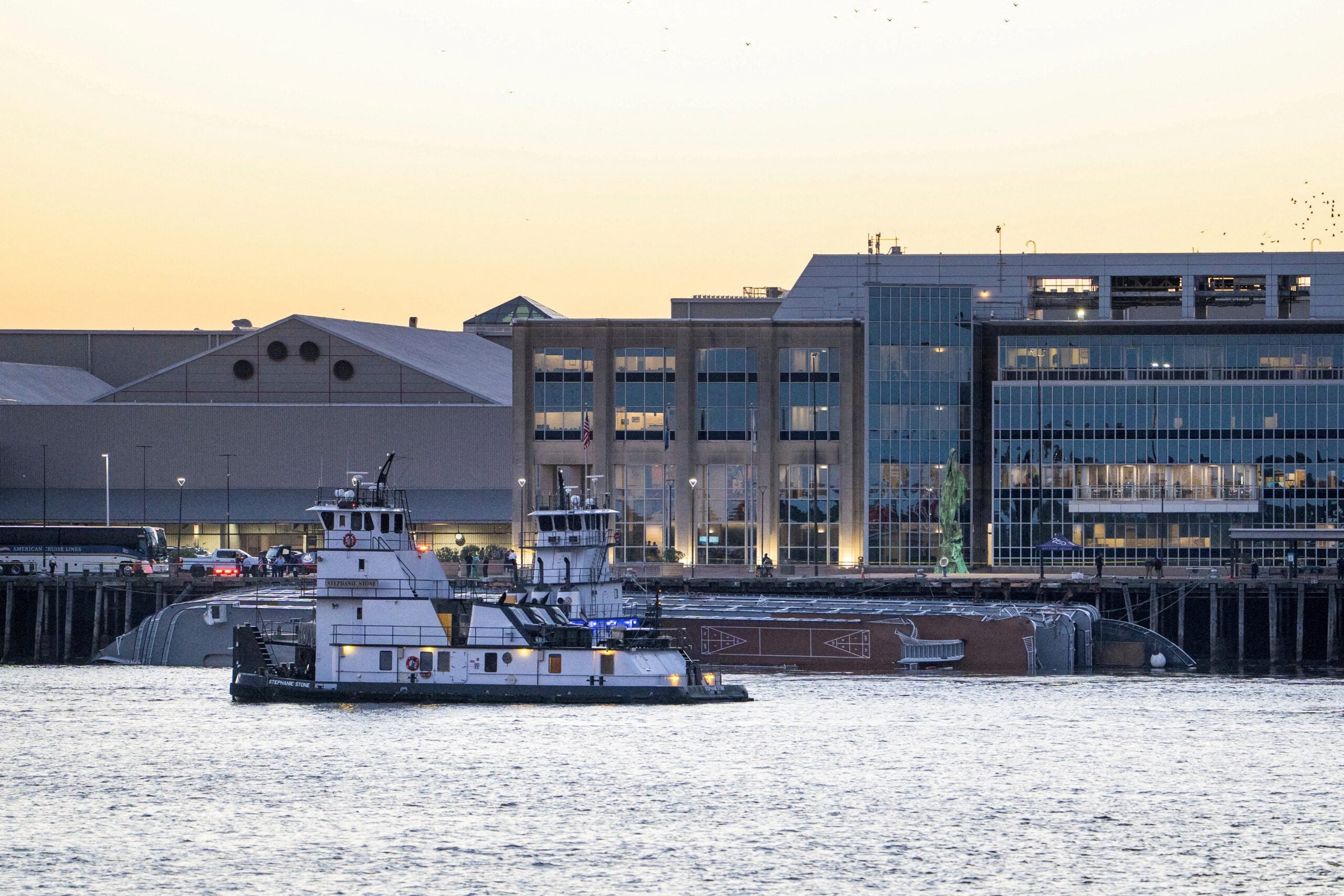
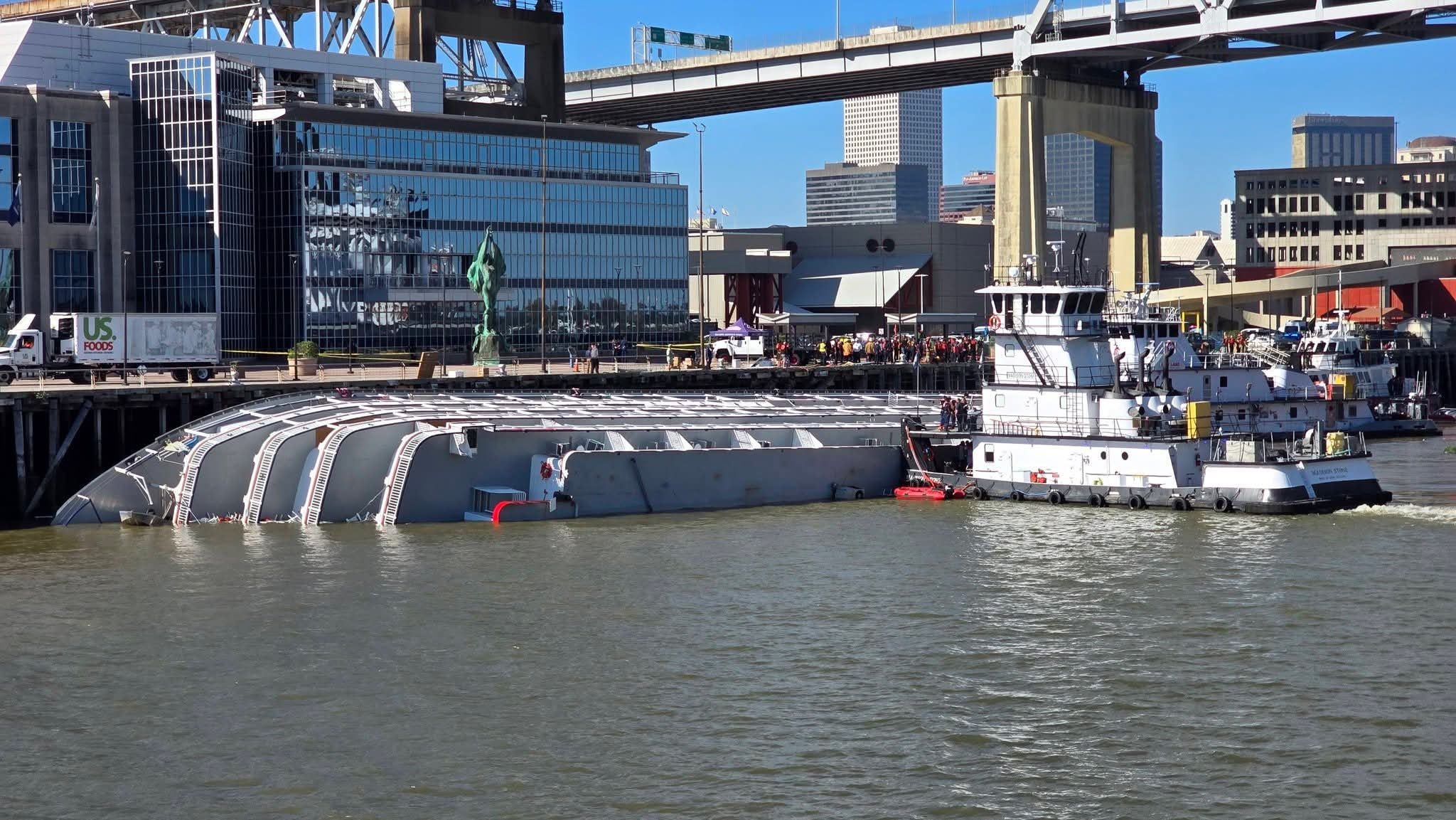
All passengers and crew aboard an American Cruise Lines riverboat survived after a Marshall Islands-flagged asphalt tanker struck the docked paddle-wheeler on the Mississippi River in New Orleans on Friday, causing it to capsize and sending people into the water.
New Orleans Mayor Helena Moreno confirmed that everyone aboard the American Heritage had been accounted for following a massive rescue operation. Thirty-two people were taken to local hospitals, including 30 passengers and two police officers, but none suffered critical injuries.
“We have zero people unaccounted for, which truly is a miracle on the Mississippi,” Moreno said at a news conference.
The 160-meter tanker Atlantic Asphalt struck the U.S.-flagged American Heritage at approximately 12:30 p.m. local time as it was traveling upbound on the Lower Mississippi River, just below the Crescent City Connection bridge, according to the Port of New Orleans.
Video of the collision shows the much larger tanker striking the docked paddlewheeler, which began taking on water and listing heavily before eventually capsizing alongside the dock. Other footage shows people in the river wearing life jackets as tugboat operators, nearby vessel crews, police and emergency responders rushed to pull them to safety.
The American Heritage had docked outside the Port of New Orleans Administration Building approximately two hours earlier to begin disembarking passengers following an eight-day Mississippi River cruise. Port officials initially reported approximately 129 passengers aboard, in addition to crew members.
Moreno said passengers began evacuating after the initial impact, but the vessel overturned before everyone could get off, forcing rescuers to pull people from the water.
Louisiana Governor Jeff Landry praised the response, calling the outcome “nothing short of a miracle.”
“While we will continue to work through the details of this incident, one thing is clear: our first responders on the national, state, and local level saved countless lives today, and for that I and all of our country are thankful!” Landry said.
American Cruise Lines Arranging Hotels for Survivors
In an updated statement Friday, American Cruise Lines said it was arranging hotel accommodations and assistance for everyone who had been aboard the American Heritage.
“We are getting everyone who was aboard the ship settled into hotels and making sure they have everything they need,” the company said.
American Cruise Lines also thanked the U.S. Coast Guard, its crew and local first responders for their rescue efforts, adding that it remained in close contact with the Coast Guard, New Orleans Police and other agencies.
Possible Steering Failure Under Investigation
The cause of the collision remains under investigation, although the U.S. Coast Guard said the tanker may have experienced a steering failure.
Coast Guard Capt. Melanie Burnham said the tanker appeared to have experienced “some type of loss of steering,” but emphasized that the exact cause had not been determined.
The National Transportation Safety Board has launched an investigation and is sending a team to New Orleans, with investigators expected to arrive Saturday morning.
The Coast Guard also closed the Mississippi River to vessel traffic between mile markers 93 and 96 while emergency operations continued, temporarily disrupting navigation along one of the nation’s busiest commercial waterways. Officials said they were evaluating when the waterway could safely reopen.
According to MarineTraffic, the Atlantic Asphalt is a 160-meter asphalt and bitumen tanker sailing under the Marshall Islands flag. The American Heritage is an 81-meter U.S.-flagged paddlewheel cruise ship built in 2015 with accommodations for up to 150 passengers.
AIS data shows the Atlantic Asphalt called at Amuay, Venezuela, in October before arriving in Paulsboro, New Jersey. The tanker departed Paulsboro on October 26 and arrived in New Orleans on November 11, two days before the collision.
The investigation will focus on what caused the tanker to strike the docked passenger vessel along the busy Lower Mississippi River, where deep-draft oceangoing ships regularly navigate in close proximity to river cruise vessels, tugs and barges.
This is a developing story.

 Join The Club