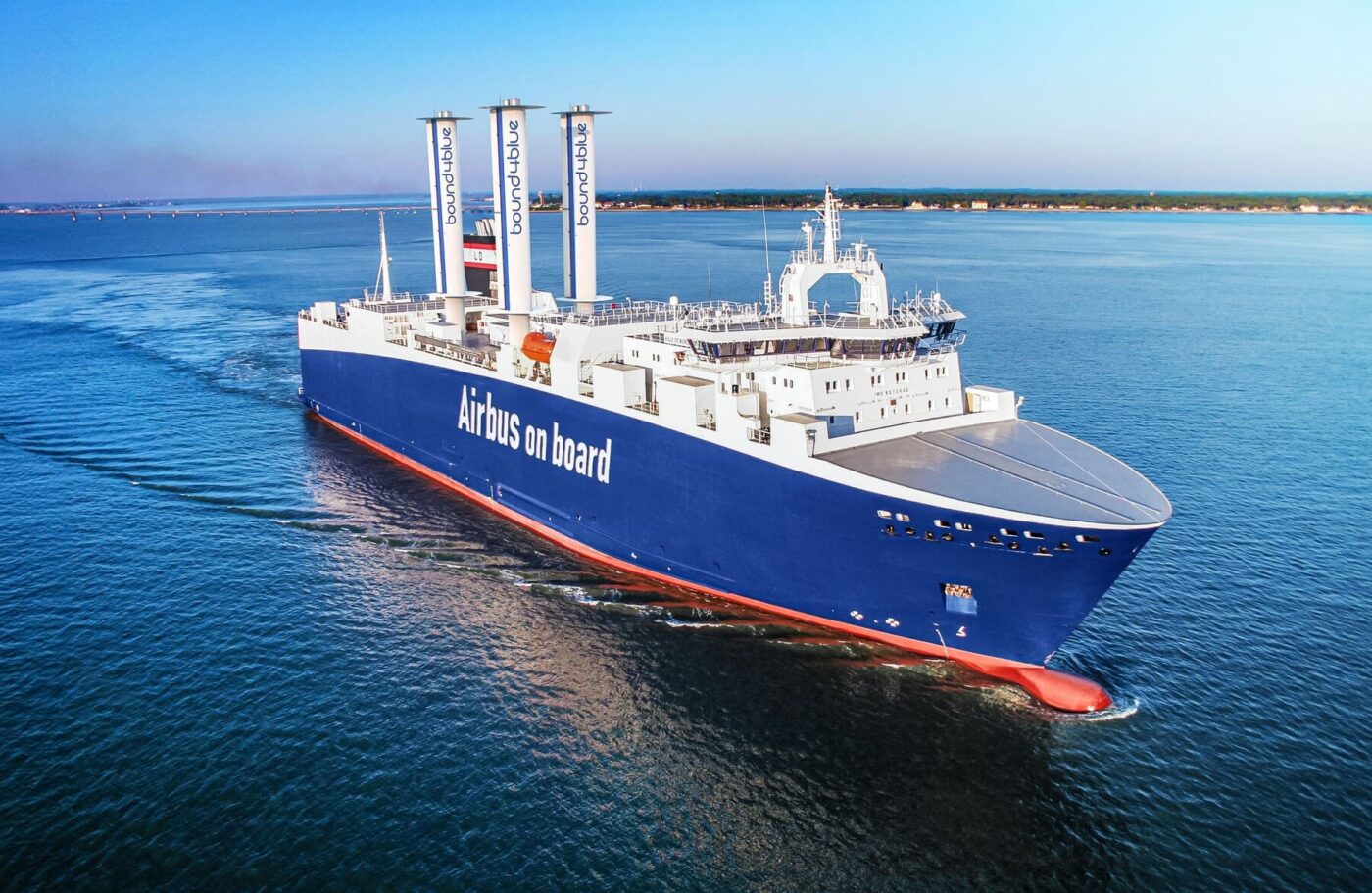
France-based sustainable aerospace company Airbus, in collaboration with shipowner Louis Dreyfus Armateurs and Spain-based firm bound4blue, is set to equip one of its aircraft subassembly transport ships with bound4blue’s wind-assisted propulsion technology.
The technology, known as eSAIL®, harnesses wind energy to generate thrust, resulting in substantial fuel consumption and CO2 emissions savings.
The system features a sail-like vertical surface and an electric-powered air suction system, creating up to seven times more lift compared to conventional rigid sails, according to bound4blue. By helping the airflow to re-adhere to the sail, the system generates additional lift, thereby reducing the load on the ship’s main engines.
The Ville de Bordeaux, a vessel chartered by Airbus to transport aircraft assembly components from Europe to the United States, will be fitted with three 22-meter-high eSAILs®. A six-month performance monitoring period will commence in early 2024 to assess the technology’s effectiveness.
For bound4blue, the installation will mark the first in the Roll-on/Roll-off (Ro-Ro) sector and third overall.
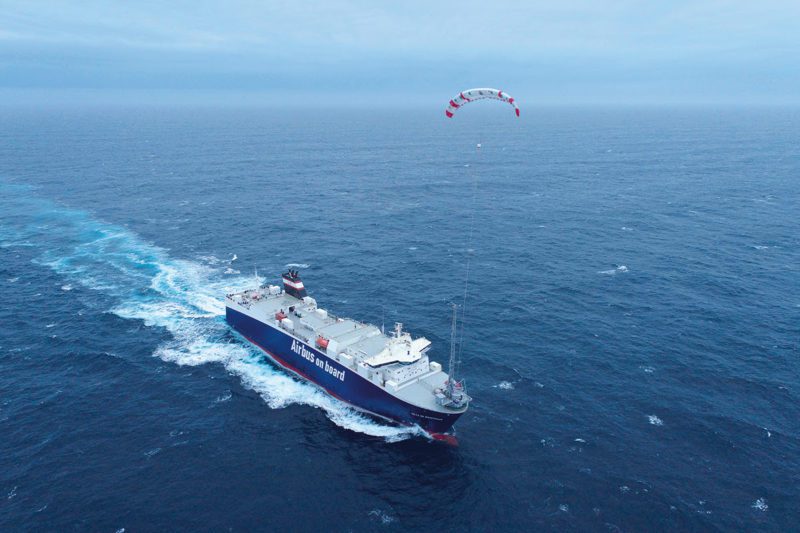
Ville de Bordeaux made headlines last December when it tested an automated kite system, known as Seawing, on a voyage from Europe to the United States. The Seawing system is developed by Airseas, a company that counts Airbus as a minority shareholder and launch partner.
The Ville de Bordeaux tests Airseas’ Seawing kit system during a transatlantic voyage in 2022. Photo Credit: Airseas
The use of wind-assisted propulsion on the Ville de Bordeaux aligns with Airbus’ commitment to cutting CO2 emissions from its maritime operations by 50% by 2030, using a 2015 baseline. bound4blue estimates that the sails could result in annual fuel savings of up to 560 tons and CO2 emissions reductions of up to 1,800 tons for the ship.
This project is co-funded by the European Union, highlighting the collaborative efforts to promote sustainable maritime solutions.
Airbus’ Head of Sustainability & Environment, Nicolas Chrétien, shared his excitement for the project, highlighting the company’s commitment to exploring new and innovative approaches to enhance sustainability in its operations.
“This technology looks promising and we are eager to start testing it in real conditions by the end of the year,” Chrétien said.
Louis Dreyfus Armateurs, the shipowner partnering with Airbus, shares a commitment to decarbonizing the shipping industry. Mathieu Muzeau, Transport & Logistic General Manager at Louis Dreyfus Armateurs, highlighted the importance of wind-assisted propulsion in achieving their objective of net-zero greenhouse gas emissions by 2050.
“Wind-assisted propulsion is one of the solutions we believe will help us reach this objective. To determine the best technology for our operations, we are eager to identify and test various forms of wind-assisted propulsion, including rotating vertical cylinders, flexible sails, rigid sails, and wings,” said Muzeau.
David Ferrer, CTO of bound4blue said the project will mark the first-ever fixed suction sail installation on a Ro-Ro ship.
“After having implemented and proven our technology on three ships already, we’re excited to install our 22-metre eSAILs on Ville de Bordeaux. This deployment will mark the first-ever fixed suction sail installation on a Ro-Ro ship, demonstrating that suction sails can be deployed on ships with high weather deck and large windage area, not compromising the vessel’s stability,” said Ferrer.
The push to bring nuclear energy back into commercial shipping is gaining momentum as the American Bureau of Shipping (ABS) and South Korea’s HD Hyundai shipbuilding group launch a new effort to study nuclear-powered...
The latest session of the IMO’s Pollution Prevention and Response Sub-Committee didn’t deliver sweeping new rules, but beneath the technical drafting work, PPR 13 signaled a clear shift toward performance-based environmental oversight. From biofouling and Arctic black carbon to scrubber discharges and low-load engine certification, the focus is moving beyond installed equipment to how ships are actually operated, maintained, and managed over their full lifecycle.
A coalition of environmental and clean-shipping groups is urging the International Maritime Organization to block any move that would allow ammonia-fueled ships to discharge toxic waste at sea, warning that shipping’s push toward zero-emission fuels must not come at the expense of ocean health.
February 13, 2026
Total Views: 1336
Get The Industry’s Go-To News
Subscribe to gCaptain Daily and stay informed with the latest global maritime and offshore news
— just like 107,453 professionals
Secure Your Spot
on the gCaptain Crew
Stay informed with the latest maritime and offshore news, delivered daily straight to your inbox
— trusted by our 107,453 members
Your Gateway to the Maritime World!
Essential news coupled with the finest maritime content sourced from across the globe.

 Join The Club