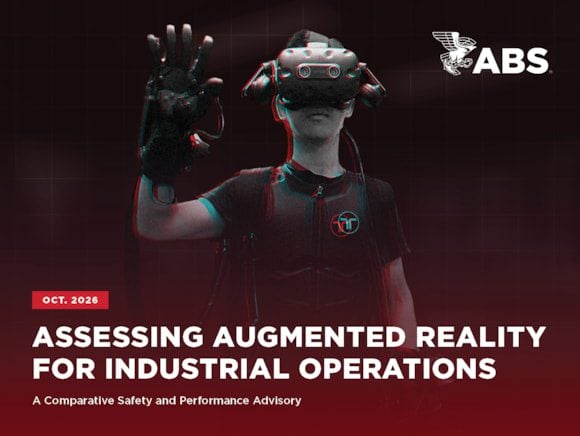
Augmented reality (AR) can help industrial crews perform tasks more efficiently and consistently, but widespread deployment will depend on demonstrating that productivity gains can be achieved without compromising safety.
That’s the core message from ABS in its latest publication, which supports marine and offshore operators as they evaluate whether AR applications are right for their crews. The ABS Advisory on Assessing Augmented Reality for Industrial Operations provides insight into how to evaluate AR’s effects on safety and performance for tasks such as inspection, maintenance, navigation, training and remote assistance, and how those effects compare with current work practices.
“Augmented reality could change how industrial work is performed, bringing expert guidance, operational data and digital workflows directly into the user’s field of view. To unlock that potential responsibly, industry needs a clear understanding of the safety and performance implications. This advisory provides the tools to evaluate the implications rigorously and consistently,” said Patrick Ryan, ABS Senior Vice President and Chief Technology Officer.
AR’s key advantage is its ability to place relevant information directly in the user’s line of sight. The technology can display step-by-step procedures in front of a technician, mark inspection points and tolerances on equipment, and flag hazard zones and exclusion areas as crews move through a space. Real-world benefits, however, depend on the task, the user and the operating environment.
Developed with support from the ABS Laboratory for Ocean Innovation at Texas A&M University, the advisory outlines a structured methodology for comparing AR-enabled tasks with baseline practices across safety and performance dimensions. It highlights how different types of tasks, such as those relying on navigation, hand-eye coordination, memory or information processing, place different demands on users, making it important to evaluate AR for the specific task it would support. The advisory also reviews the trade-offs AR applications can introduce, including distraction, visual occlusion and overreliance on system outputs.
As AR moves from pilot projects to daily use, ABS will continue working with the industry to support the safe adoption of new technology. Download a copy of the advisory here.

 Join The Club