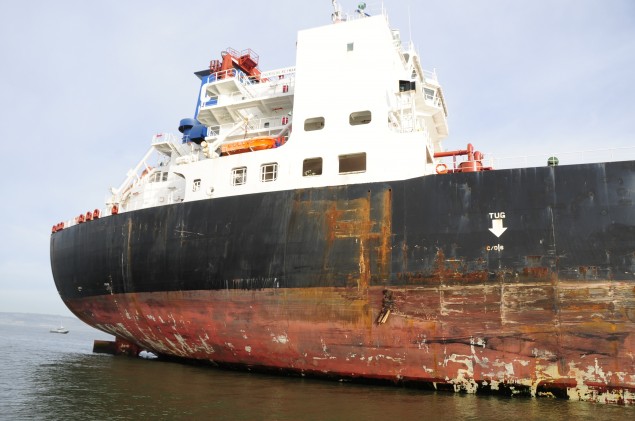
Washington, DC – The National Transportation Safety Board determined today that a medically unfit pilot, an ineffective master, and poor communications between the two were the cause of an accident in which the Cosco Busan container ship spilled thousands of gallons of fuel oil into the San Francisco Bay after striking a bridge support tower.
On November 7, 2007, at about 8:00 a.m. PST, in heavy fog with visibility of less than a quarter mile, the Hong Kong- registered, 901-foot-long container ship M/V Cosco Busan left its berth in the Port of Oakland destined for South Korea. The San Francisco Bay pilot, who was attempting to navigate the ship between the Delta and Echo support towers of the San Francisco-Oakland Bay Bridge, issued directions that resulted in the ship heading directly toward the Delta support tower. While avoiding a direct hit, the side of the ship struck the fendering system at the base of the Delta tower, which created a 212-foot-long gash in the ship’s forward port side and breached two fuel tanks and a ballast tank.
As a result of striking the bridge, over 53,000 gallons of fuel oil were released into the Bay, contaminating about 26 miles of shoreline and killing more than 2,500 birds of about 50 species. Total monetary damages were estimated to be $2 million for the ship, $1.5 million for the bridge, and more than $70 million for environmental cleanup.
“How a man who was taking a half-dozen impairing prescription medications got to stand on the bridge of a 68,000-ton ship and give directions to guide the vessel through a foggy bay and under a busy highway bridge, is very troubling, and raises a great many questions about the adequacy of the medical oversight system for mariners,” said Acting Chairman Mark V. Rosenker. [Continue Reading →]
Tuesday evening, the tanker Overseas Cleliamar lost all power while exiting San Francisco Bay just west of the Golden Gate Bridge. The 741-ft tanker, on its way to its next port of call in Ecuador, was carrying no cargo at the time of the incident. Despite initial conflicting reports, the tanker did not hit any rocks and credit is being given to the quick actions of the pilot and crew for preventing any major catastrophe. The San Francisco Chronicle has the dramatic details:
Capt. Dave McCloy, a bar pilot for about a year, had just minutes to stop the tanker from crashing into the steep rockbound cliffs of the Marin Headlands just outside the Golden Gate.
McCloy had just ordered the ship’s helm put slightly to the right. So when the Overseas Cleliamar lost power, it was headed for the rocks.
McCloy acted fast. He directed the crew of the tanker to lower the starboard anchor, one of two massive anchors carried on the bow. He had the anchor lowered only partially, so that it would take hold in shallower water close to the shore. [Continue Reading →]
This morning Senator Barbra Boxer and Representative Nacy Pelosi, Speaker of the House, announced a bill giving the U.S. Coast Guard broader authority to direct the actions of ship masters in navigating inland waters. The San Francisco Chronicle tells us;
The Coast Guard would gain new authority to order ships to reduce speed or shift course during emergencies or hazardous conditions under new legislation that California Sen. Barbara Boxer is introducing this week.
The bill could increase the responsibilities of the Coast Guard’s Vessel Traffic Service, which helps guide ships in U.S. harbors. The measure would give it powers akin to those of air traffic controllers, who issue step-by-step directions to airplane pilots.
…
Boxer, a Democrat, said she believes the spill could have been prevented if the Coast Guard had ordered the ship to slow down or change course.
“I absolutely think it would have” prevented the spill, Boxer said. “Let’s say the conditions were fierce – and they were – (the Vessel Traffic Service) would have declared an emergency, and they would have taken over in guiding this ship.” Continue Reading….
Regular readers of this bog already know my personal thoughts on the subject. In last week’s editorial, I wrote;
The problem with maritime incidents is the fix rarely address the true cause and often creates problems that contribute to future incidents.
…
Current technology is simply not capable of delivering real time tracking. Also, final say remains the responsibility of a ship’s captain because he is the one who knows the ship’s capabilities, it’s crew and he is stationed on the bridge. He is also the last one to abandon if the ship finds danger… and he knows it.
If the Coast Guard wants final say then they need to be aboard the vessel and if that happens they will be hard pressed to fill the position with anyone more qualified than the competent and experienced San Francisco Pilots.
My comments resulted in 5 emails, 2 phone calls and a, well written, personal response by our friend Bob Couttie of the Maritime Accident Casebook. Bob wrote;
MAC’s own informal think-tank of veteran master mariners, who aren’t tanked up when they think, finds the proposal less objectionable, the authority of the master will remain in force much as it does now, in their view. Continue Reading…
This comment cause me to invest more than a few hours in nocturnal contemplation. Had I overestimated the potential outcome of the Coast Guard’s overtly defensive and seemingly irrational stance or has Bob’s geographic location far away from our shores disconnected him from the current state of American politics?
Provided the Chronicle has accurately conveyed Senator Boxer and Representative Pelosi’s intent, gCaptain reader ACI’s comment most accurately portrays the sentiment of our master mariner think tank;
Keep on putting more constrains to the shipping business with your new ridiculous American fear to everything and we will end up with no business at all. I know of captains that are refusing to sail to your country.
I really loved the times when the US was leading the world towards modernity, now it seems you are too scared.
The likely impetus for drafting legislation that puts us in the ironic position of being more likely to have a future incident is the demand for quick answers. For this reason I can not form a personal opinion as to maritime pilot John Cota’s culpability, at least not until the NTSB report is published. I can, however, give an industry insider’s opinion on the safety of current operations in the bay… so I wish to reiterate my personal feelings that both the San Fransisco Bar pilots and local VTS operators are among the most capable and well trained in the world. This, coupled with the fact US Coast Guard and State pilot officials have not asked for these changes, is worrisome.
Regardless of the headlines Pelosi’s bill does contain some element of potential good. The Chronicle writes;
Boxer’s bill would authorize $20 million to upgrade the technology used by the Vessel Traffic Service. The measure also would require all pilots to have their own navigational laptop computers. Cota has said he was unfamiliar with the ship’s electronic charts. Many pilots bring their own laptops on board to make sure they have reliable navigational charts to steer the ship.
The state pilot commission suspended Cota’s license on Friday. Cota’s attorney, John Meadows, has said his client was given “wrong information” by the ship’s captain, Mao Cai Sun.
History has proven that safe operations in the bay are possible without advanced electronics and I will not be surprised if the NTSB’s report places some degree of blame on the rapid integration of new technology on the bridge, a problem only made worse by already burdensome training requirements. This, however, does not mean we can ignore technological improvements.
For an intelligent discussion of the topic I’ll point you to audio from Captain Kelly Sweeney’s recent interview with NPR (CLICK HERE). Boiled down he states that we as mariners love AIS, ECDIS and other technology that keep us safe but improvements (most notably in implementation and redundancy) are needed.
But I’m still an optimist. When this discussion fades into memory we may find Pelosi’s large investment propelled interesting technological improvements while our worries were mitigated by the level headed watchmen of VTS.
*We’d love to head your thoughts! Click here and leave a comment (bottom of page) or contact us with your message.
John Konrad is a USCG licensed Master Mariner of Unlimited Tonnage. Since graduating from SUNY Maritime College he has sailed 4 of the world’s oceans and reports from his ship via satellite. John lives in Morro Bay, CA with his wife Cindy and son Jack.
“At 8:30 am this morning, the Cosco Busan, an 810-foot container ship, collided with the base of one of the towers of the San Francisco-Oakland Bay Bridge while the ship was under the control of a Bar Pilot. The crash created a huge gash in the side of the ship and triggered an oil leak that created an environmental mess in San Francisco Bay.” More to come but Telstar Logistics has the full story from a local perspective LINK.

In related news New York’s Ambrose Light experienced an allision earlier this week but this one seems to be part of a trend. I don’t have specifics on this particular incident but the previous ones we’ve heard of were due to failed crash astern tests, a requirement of the port, that were conducted too close to the pilot station. Gothamist has the details on this one LINK.
If you have the inside scoop or would like an experts opinion for your article or post please contact us;