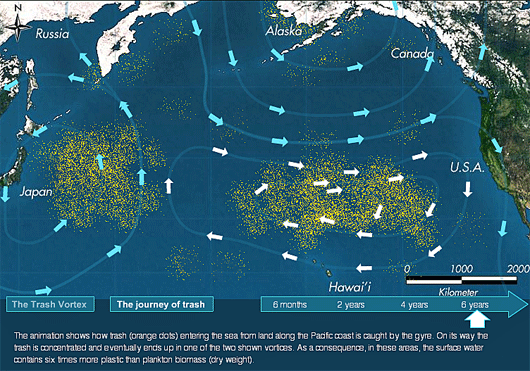
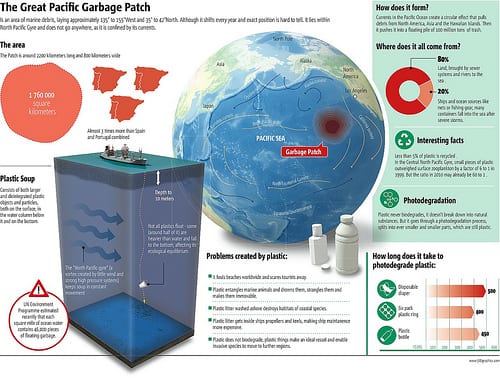
In the broad expanse of the northern Pacific Ocean, there exists the North Pacific Subtropical Gyre, a slowly moving, clockwise spiral of currents created by a high-pressure system of air currents. The area is an oceanic desert, filled with tiny phytoplankton but few big fish or mammals. Due to its lack of large fish and gentle breezes, fishermen and sailors rarely travel through the gyre. But the area is filled with something besides plankton: trash, millions of pounds of it, most of it plastic. It’s the largest landfill in the world, and it floats in the middle of the ocean.
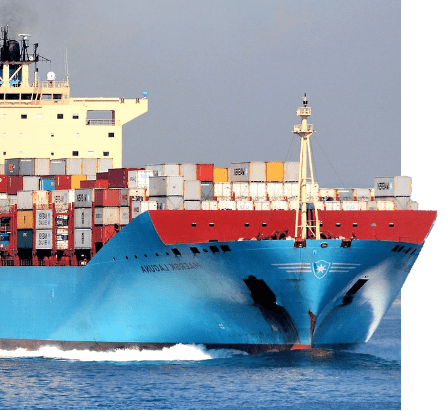
The primary sources of ocean debris include storm sewers, illegal dumping, littering, commercial and recreational boats, and commercial shipping.
The gyre has actually given birth to two large masses of ever-accumulating trash, known as the Western and Eastern Pacific Garbage Patches, sometimes collectively called the Great Pacific Garbage Patch. The Eastern Garbage Patch floats between Hawaii and California; scientists estimate its size as two times bigger than Texas. The patch is characterised by exceptionally high concentrations of suspended plastic and other debris that have been trapped by the currents of the North Pacific Gyre.
The main problem with plastic — besides there being so much of it — is that it doesn’t biodegrade. No natural process can break it down. (Experts point out that the durability that makes plastic so useful to humans also makes it quite harmful to nature.) Instead, plastic photodegrades. A plastic cigarette lighter cast out to sea will fragment into smaller and smaller pieces of plastic without breaking into simpler compounds, which scientists estimate could take hundreds of years. The small bits of plastic produced by photodegradation are called mermaid tears or nurdles.
Besides the obvious affects this has on both marine life and tourism, another question that presents itself is how do we clean this up?
This question is yet to be answered. For now, experts say the best approach we have is not to clean it up at all, but to keep it from growing.
By Yimou Lee TAIPEI, March 7 (Reuters) – China has stepped up grey-zone warfare against Taiwan, aiming to make the areas around the democratic island “saturated” with balloons, drones and civilian boats,...
Austal USA has kicked off plans to construct a new manufacturing facility, marking a significant expansion of its shipyard capacity in Mobile, Alabama in support of U.S. Navy and Coast...
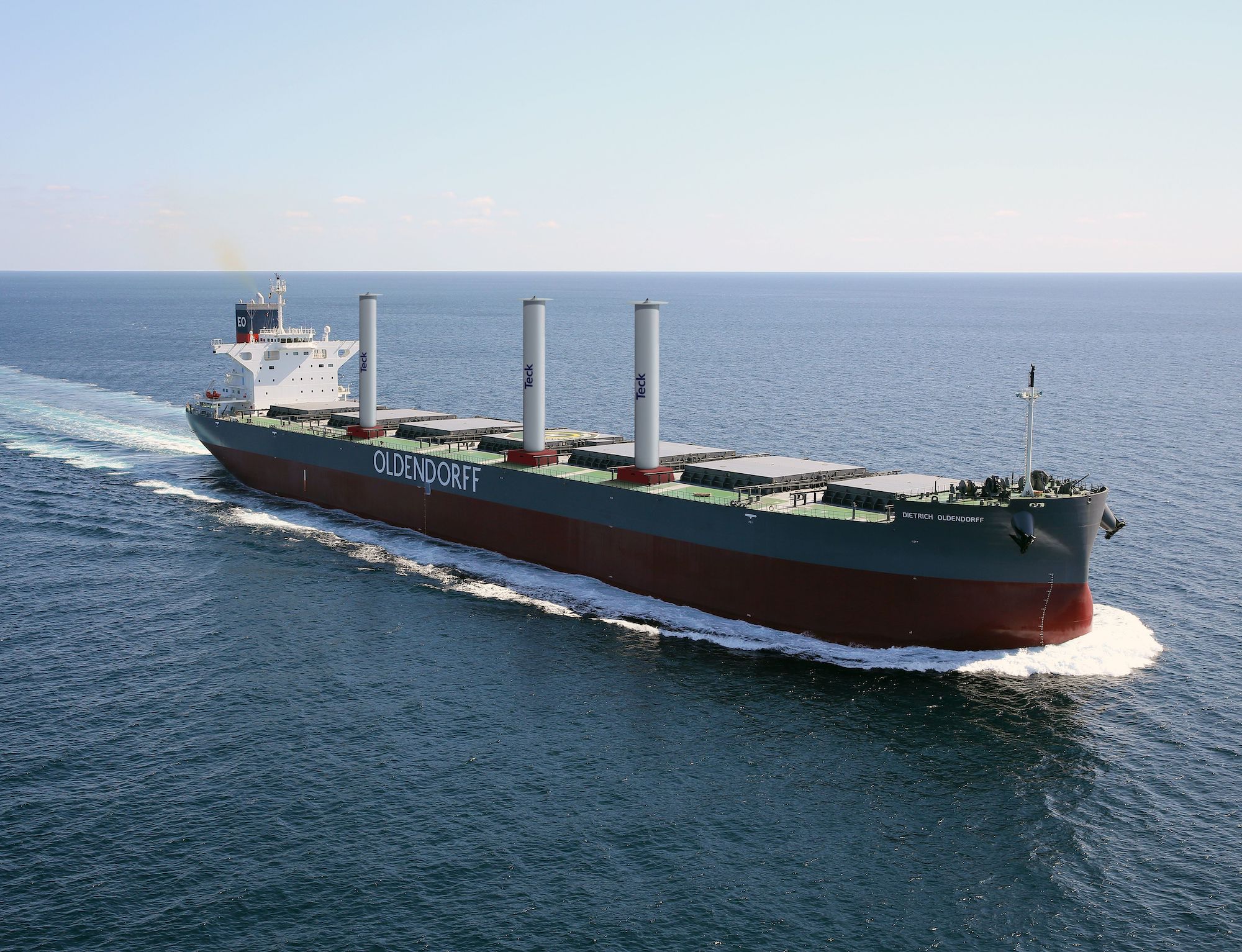
Oldendorff and Norsepower have announced an agreement to install three Norsepower Rotor Sails™ on board a modern bulk carrier to reduce its emissions. The vessel, Dietrich Oldendorff, will be equipped...
February 5, 2024
Total Views: 839
Why Join the gCaptain Club?
Access exclusive insights, engage in vibrant discussions, and gain perspectives from our CEO.
This website uses cookies to improve your experience while you navigate through the website. Out of these, the cookies that are categorized as necessary are stored on your browser as they are essential for the working of basic functionalities of the website. We also use third-party cookies that help us analyze and understand how you use this website. These cookies will be stored in your browser only with your consent. You also have the option to opt-out of these cookies. But opting out of some of these cookies may affect your browsing experience.
Necessary cookies are absolutely essential for the website to function properly. This category only includes cookies that ensures basic functionalities and security features of the website. These cookies do not store any personal information.
Any cookies that may not be particularly necessary for the website to function and is used specifically to collect user personal data via analytics, ads, other embedded contents are termed as non-necessary cookies. It is mandatory to procure user consent prior to running these cookies on your website.

 Join The Club