Researchers from Sweden’s Uppsala University have recently released some findings of a rather interesting study that dispel popular beliefs dating back to the Titanic about the anatomy of shipwreck survival.
According to the study, titled “Every Man for Himself: Gender, Norms and Survival in Maritime Disasters“, researchers found that in the case of a maritime disaster the age-old ‘women and children first’ does not hold, and in reality is more like ‘every man for himself’. In fact, women and children have substantially lower chance of survival than men, particularly than that of the captain and crew, the study finds.
In order to come to this conclusion the study’s authors, economists Mikael Elinder and Oscar Erixson, analyzed data based on 18 of the most notable shipwrecks during the period 1852 to 2011 with information on the fates of more than 15,000 people with one, well two, critical-yet-obvious exceptions; the RMS Titanic and RMS Lusitania. Why not include these? Simply put, the Titanic (and RMS Lusitania) disasters were exceptional.
The report states that on the ships where the captain gave the order ‘women and children first’, i.e. Titanic and Lusitania, the difference in survival rates between men and women is lower, but the study found that women survived to a higher extent than men only when this order was enforced by the threat of violence. This, however, is rare and by including the two aforementioned exceptions the results get severely skewed.
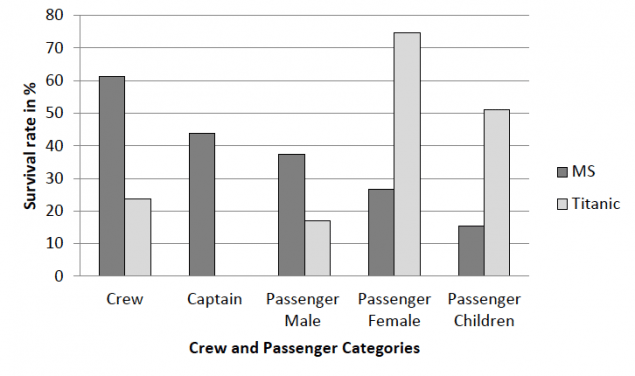
Specifically, the study shows that women have a significantly lower chance of survival than men (17.8% vs. 34.5%), children have the lowest chance of survival, and captain and crew are 18.7% more likely to survive than passengers.
But why are crew members more likely to survive?
Here’s the real zinger. The study found that, and we’re pretty sure some of you will disagree here, it is actually common that captains leave the ship and save themselves before overseeing the safe rescue of all passengers. Remember they said it not me, IT IS COMMON TO HAVE CAPTAINS AND CREW SAVE THEMSELVES BEFORE PASSENGERS.
Therefore, according to the study anyway, our favorite scapegoat Captain Francesco Schettino in the case of the Costa Concordia disaster is not at all an exception, but rather quite common in maritime disasters.
So what does this study mean?
Well, according to the reports findings, this indicates an important role of leaders in the face of disasters, and more widely, how this contributes to our understanding of how people behave under extreme stress and when it is a matter of life and death.
Survival rates of passengers and crew (survival rates of children is only available for 9 shipwrecks in Main Sample (MS))
by Kevin Hamilton (University of Hawaii) In 2021, an expedition off the icy northern Greenland coast spotted what appeared to be a previously uncharted island. It was small and gravelly,...
Editor’s Note: This article was originally published by gCaptain in 2016 and is being republished now because it’s lessons are timeless and possibly more relevant in 2022 as today’s ships...
by Salvatore R. Mercogliano, Ph.D. (gCaptain) This Veteran’s Day we remember the thousands of Soldiers, Sailors, Marines, Airmen, and Coast Guardsmen who gave their lives in defense of the United States...
November 11, 2022
Total Views: 1533
Why Join the gCaptain Club?
Access exclusive insights, engage in vibrant discussions, and gain perspectives from our CEO.
This website uses cookies to improve your experience while you navigate through the website. Out of these, the cookies that are categorized as necessary are stored on your browser as they are essential for the working of basic functionalities of the website. We also use third-party cookies that help us analyze and understand how you use this website. These cookies will be stored in your browser only with your consent. You also have the option to opt-out of these cookies. But opting out of some of these cookies may affect your browsing experience.
Necessary cookies are absolutely essential for the website to function properly. This category only includes cookies that ensures basic functionalities and security features of the website. These cookies do not store any personal information.
Any cookies that may not be particularly necessary for the website to function and is used specifically to collect user personal data via analytics, ads, other embedded contents are termed as non-necessary cookies. It is mandatory to procure user consent prior to running these cookies on your website.

 Join The Club