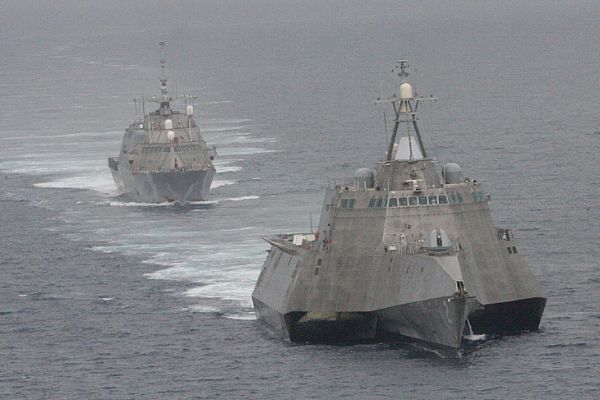
The first of class littoral combat ships USS Freedom (LCS 1), rear, and USS Independence (LCS 2) maneuver together during an exercise off the coast of Southern California. Photo: U.S. Navy
The U.S. Navy on Wednesday announced that it has established a board of vice admirals tasked with tackling issues that have arisen from the often contested LCS Program.
The board, known as the LCS Council, will be made up of four vice admirals who will “oversee continued fleet testing and introduction of littoral combat ship (LCS) sea frames, mission modules, and mission packages.”
Since its inception, the 55-ship LCS program has been the butt of harsh criticism concerning their prospective mission performance and cost-effectiveness, combat survivability, and even hull cracking and engine problems and corrosion as experienced by LCS-1 and LCS-2.
READ: Challenging the LCS Program
“Addressing challenges identified by these studies, on the timeline we require, necessitates the establishment of an empowered council to drive action across acquisition, requirements and fleet enterprises of the Navy,” says Chief of Naval Operations, Adm. Jonathan Greenert, who formally established the board.
In a statement the U.S. Navy admits that as with any first-of-class shipbuilding, issues are expected to arise. “Navy ships are designed with test and trial periods to ensure everything is working correctly, and repairs can be made, if required,” the statement says. “That approach also allows for the incorporation of lessons learned into the follow-on ships before they’re delivered.”
“I am confident we are on a path of success for LCS,” says Secretary of the Navy Ray Mabus. “This council will continue to unify our efforts to implement operational lessons learned from our research and development ships to further ensure successful fleet integration.”
As first-of-class research and development (R&D) ships, LCS 1 and LCS 2 have provided lessons learned that the Navy says have already led to design and production improvements on follow-on ships.
“All Navy combat ships, even test and evaluation platforms, must be ready to meet assigned missions starting with the first day of active service – LCS is no exception,” said Greenert.
Now, efforts are focused on transitioning from testing initial R&D ships to operationally employing LCS and ensuring the Navy is prepared to man, train, and equip the class in the most efficient and effective manner. The LCS council will use a comprehensive review process to critically examine areas that need to be addressed before LCS deploys to Singapore next spring, to determine what areas need to be studied closer during that deployment, as well as identify what issues need a longer-term look.
The LCS Council Board Members:
Adm. Jonathan Greenert designated Vice Adm. Rick Hunt, director of the Navy Staff, as the council’s chairman. Other officers on the council include Vice Adm. Mark Skinner, Principal Military Deputy to the Assistant Secretary of the Navy for Research, Development and Acquisition; Vice Adm. Tom Copeman, commander, Naval Surface Forces; and Vice Adm. Kevin McCoy, commander, Naval Sea Systems Command.
Unlock Exclusive Insights Today!
Join the gCaptain Club for curated content, insider opinions, and vibrant community discussions.

 Join The Club