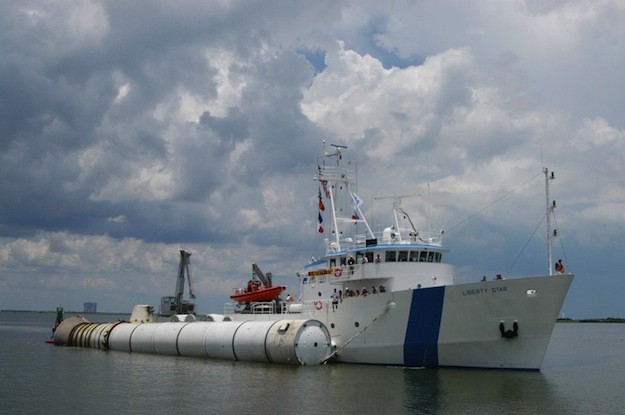
M/V Liberty Star. Image via NASA

U.S. Transportation Secretary Ray LaHood announced Tuesday that the Maritime Administration has struck a deal with NASA to convert a former space shuttle rocket booster recovery ship into the U.S. Merchant Marine Academy’s new training ship.

The agreement, signed today by the Department of Transportation and NASA, outlines plans for the transfer of the M/V Liberty Star to USMMA following some shipyard work to increase onboard berthing and full conversion to a training vessel.

“Securing this modern vessel supports the goals outlined in the Academy’s new strategic plan and will ensure our midshipmen get the top-notch education and training they need to compete and win in a competitive global marketplace,” said Secretary LaHood.

MARAD came under intense scrutiny in December when it was revealed the department reassigned USMMA’s former training ship, the T/V King’s Pointer, to Texas A&M, leaving the Nation’s only federal maritime academy without a training ship.  A big deal in and of itself, but even bigger since the Academy was already reeling from a fallout of its top leaders and the closing of GMATS, a self-funded professional training organization located on the King’s Point campus.

“This past April, when we toured the Academy, I asked for three things and today we are batting 3 for 3,”  said Senator Charles E. Schumer. “We have a new superintendent in place, we were able to increase capital funding in the senate appropriations bill and now we have a new training vessel on its way.

“We are righting this ship not only for the midshipmen currently attending, but for the generations of students who will come. The Merchant Marine Academy is getting back on course and I commend Secretary LaHood for his hard work, hearing our call and delivering promptly,” added Senator Schumer.

Like all other Maritime Administration reserve ships, MARAD says, the “Academy training ship will remain on call for occasional use – in this case NASA missions – allowing midshipmen to get at-sea experience with commercial crews.”

Since FY 2009, the Obama Administration has requested and Congress has appropriated more than $300 million for the Academy, which includes $239 million for operations and $61 million for capital improvements – including $23 million last year, the most funding ever secured for physical improvements at the Academy. The vessel will be a major component of a renewed waterfront at the Academy that includes a new pier.

Discussion: Is this a good choice of training vessel for USMMA?

About MV Liberty Star

The MV Liberty Star was one of two vessels used by NASA to recover the space shuttle’s solid rocket boosters following the launch of a space shuttle mission. Propelled by two combined 2,900 horsepower diesel engines, the 176-foot long MV Liberty Star has a 6,000 mile range and a maximum speed of 15 knots. The ship’s controllable pitch propellers and auxiliary water jet thruster, combined with “modern joy-stick dynamic positioning capability” provide midshipmen a “highly maneuverable training platform”, MARAD says. The vessel has a 7,500 pound deck crane, providing for a basic understanding of cargo operations. It also has a fast rescue boat, which can provide midshipman “critical experience” in “general launch operations.” In addition, the vessel’s double towing winch, towing H bitts, and “a massive towing fairlead” also add new towing training capabilities to the Academy’s portfolio. The M/V Liberty star was built in 1981 at Atlantic Marine Shipyard in Florida.

M/V Liberty Star in Action

YouTube Preview Image

Tagged with:  
Share →


Article Comments


9 Responses to To Infinity and Beyond: NASA Rocket Ship Named New King’s Point Training Vessel

  1. avatar Edward says:

    I don’t think it is the right size of ship. It looks like a supply vessel. I guess that’s the new Brown Water policy the new super wants. Bad choice.

  2. avatar Parker says:

    I disagree. First of all, the cadets from KP get more than 300 days of sea time aboard full-scale, active merchant vessels during their sea year, which is far better practical experience than the use of a large training vessel. Secondly, we don’t have the facility to house a vessel any larger than the last Kings Pointer, and this one isn’t much smaller. Our pier facilities are not capable of handling a vessel the size of the Empire State, for instance. Thirdly, a smaller vessel will allow us to get underway far more frequently than a larger one, which is a problem we ran into with the last Kings Pointer. And lastly, while it is an older platform and not the most modern, technically sophisticated vessel, it still has systems which will be very useful in expanding our training curriculum, for areas in which we currently have no resources. We don’t need a large “blue water” ship, we have access to those already. What we don’t have is anything that serves as a training aid for nearshore, oil service, on inland shipping, which while they might not/should not be the focus of the Academy, are nevertheless something that the cadets should have the opportunity to experience. In short, I think this is a great addition to the Academy training program.

  3. avatar The Usual Suspect says:

    The appointment of a former Army Colonel as the superintendent of USMMA makes sense now that the hand of Schumer in the recent goings on has been revealed.

  4. I believe something is better than nothing. But…It just dawn on me that since the new Kings Point boat is a 31 years old ship, it resembles the very same US fleet that has earned a place in the Gray List of the Paris MoU detention listing for substandard shipping in european ports. It is not inspiring, rather makes you aspire for a newer flagship.

    It might best serve as a platform for advance maneuvering classes. I would love to teach that with a hands on approach.

    I have been to the training ships of Mexico (both naval and merchant -it used to have double bridges-), Chile, Colombia, Spain, Mass Maritime and others.

    Let's hope that this financial crisis gives way to improvements at Kings Point.

  5. avatar Ben Dover says:

    What is going on here? First, the DOT says that the ship was too expensive to be maintained, but sends it to Texas. Then the excuse was for the pier improvements. Next, the Secretary announces that he wants to make KP the jewel of the service academies. So let’s get an old ship that is being disposed of by another federal agency? How does this make KP a jewel by teaching students on a learning platform that has been outdated for 20 years? And what is this push for brown water? Is anyone complaining about a shortage of officers there? No, there is an oversupply.

    And poor Parker, you are feeding into the propaganda being spewed by MARAD. Put down the Kool Aid cup. Do not drink it. I’m guessing that you are still at KP. You are coming from what used to be one of the world’s greatest maritime schools. Being a KPer means something in the maritime industry, both in the US and internationally. It does not give you a free ticket to anything, but it is certainly a good baseline. DO NOT SETTLE. The Administration is trying to justify its poor decisions. Striving for average and mediocrity should not be their goal or yours.

    Not one goal MARAD set out has been met. The head of the country’s federal maritime academy is an army colonel (not even flag rank) with no maritime experience? Even the state schools have at least navy guys. Now we have an old ship that no one else wanted. GMATS is gone. Next they will offer truck driving or railroad locomotive classes. This is another great disservice to KP, its students, and alumni and just another kick in the arse from the events of the last year.

  6. avatar Kevin Sorbello says:

    A training ship can come in many forms. This older ship will be fine as long as it is used as a real training platform on a daily basis. That does not mean it must be taken out to sea every day; it means the engineers need to be on it performing maintenance and overhauls of every piece of equipment. Older ships are fine because that is what they will find in the industry, and most pumps and compressors are the same regardless of the size of the ship. The problem with midshipmen sailing on large commercial vessels is that they do not often get the “hands on” experience with tearing the eqiupment apart and putting it back together;”this” ship could provide a platform to do just that, and in the process, correct a flaw in their training program. Meanwhile, ship handling in the middle of the ocean is not much ship handling at all. This smaller vessel will give mates the opportunity to work closer to shore where they have to do more than stay awake on watch. They will still get “deep water” experience, but this ship might actually give them more hands on experience than a larger ship would have allowed.

    As far as “who’s in charge” of KP, it depends on their mindset. I have been around Navy senior officers and can tell you that many have low regard for the merchant fleet and consider merchant captains “not real” captains. That, to me, is NOT the attitude that should be held by someone in charge of a maritime academy. The best choice may have been an experienced mariner who had attained an advanced degree, but the choice has been made and it will all depend on what he does from here. Since he is an unknown and has just started, we should probably give him the benefit of the doubt until he falls on his sword. KP has sufficient inertia to prevent any single leader from bringing it down overnight, so recess the jury until we know more about him.

  7. avatar Ken says:

    A couple of comments from a late 80′s KP grad.

    1) I don’t think it matters in the least that the new Superintendent is a former Army Colonel. What matters is the skill set and leadership qualities he brings to the job. The Army Transportation Command has a large number of (brown water) vessels, ammuniton depots (terminals) and Army Corps is responsible for waterways maintenance. To dismiss an Army officer as not maritime enough to lead KP is not a credible arguement.

    2) Kings Point cadets spend a year at sea on civilian merchant ships. They don’t need a training ship like the State of Maine or the Empire State. The Kings Pointer that was transfered to Texas was there in the 80′s when I graduated, and it wasn’t new when I got there. What Kings Point needs is a platform where the deck cadets can practice ship handling skills and engine cadets can perform hands on maintenance. Classroom theory is not a substitute for hands on experience, and the dirtier the cadets can get their hands the better. Whether you want to call it brown water sailing or whatever, understanding how a vessel moves and reacts can only be learned by feel, and once you understand what you are feeling it will translate from brown to blue to deep blue water.

    3) The maritime industry encompasses way more than shipboard operations. When I went to KP our choices were deck, engine, dual or engine systems. Now they’ve broadened the ciriculum to shipyard management, logistics and a host of other tracks. I completely support that decsion, because for the school stay relevant it had to happen. I don’t understand shutting down GMATS, and I think that was a mistake and hope the decision is revisited.

    In the mean time I am reserving judgement on the changes at the school to see how they effect the quality of the education that the cadets receive.

  8. avatar Dr. Faustus says:

    When I heard the KP cadets were being told to focus on brown water jobs because blue water is dead, I knew the war had been lost. I’m sorry but there is no need for a federal academy to train mates and engineers that can be sourced out of high schools or technical schools. I’m a proud deep water, state trained mariner, and the majority of KP cadets I get on my ship are not interested in shipping out as a career. They’ll tell you they are, but the proof is in the motivation. On the other hand, every state cadet I get has a far more motivated attitude toward learning everything I have to throw at them.

    CLOSE the school, re-direct a portion of the massive funding to the state schools, and get rid of all but two of the most modern training ships we can muster out of our septuagenarian fleet. Share these two ships amongst the schools seasonally and roll the excess funding back into the defunct Title XI program so we can maybe get short sea shipping off the ground. Not a popular opinion, but it’s mine and I’d like to see the American flag survive for the next generation.

  9. avatar Tom Meyer says:

    How about this for Training Vessel…maybe a bit small but definitely going in the right direction:

    http://www.navyrecognition.com/index.php?option=com_content&task=view&id=593