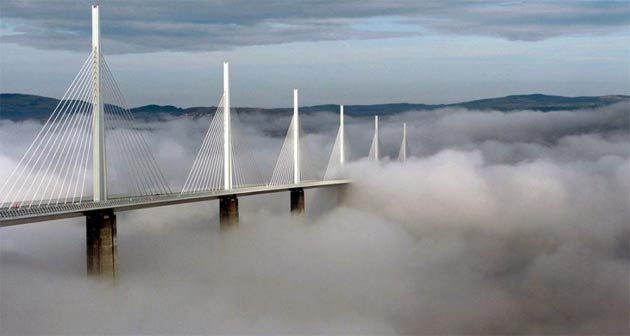
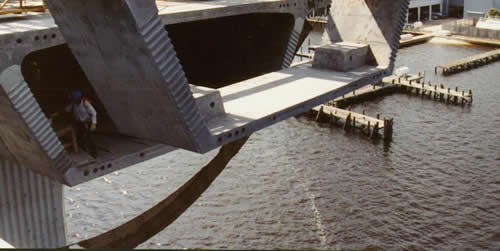
History is littered with bridges designed to do the impossible. One example, Euroroute (pictured above), would literally take drivers through the White Cliffs of Dover to an island five miles into the English Channel where a tunnel would bring drivers the twenty remaining miles to France. This bridge designs was never built of course but the dream existed.
Today bridges are being designed that would cast shadows over Euroroute’s proposed span. Here’s what is being planned. [Continue Reading →]
Related Posts:
Tags: · architecture, Bridges, design, engineering, Interesting

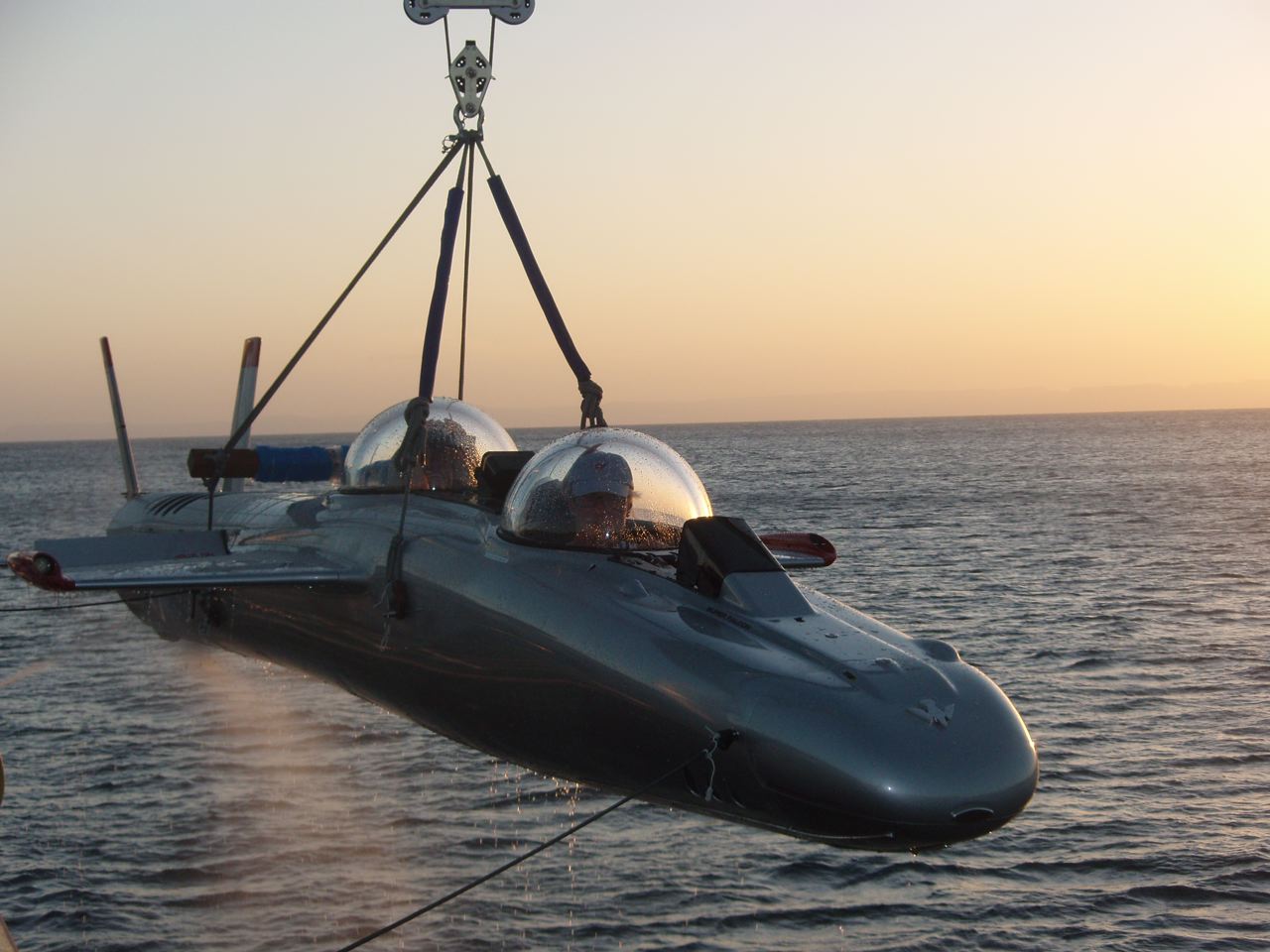
If you were lucky enough to be the owner of a multi-million dollar luxury superyacht, what kind of toys would you want to have on it to show off to your not so lucky friends. A pair of jet skis? Child’s play. A nice power boat? Way too typical. A heli-pad? You’re starting to get the picture. How about a full ocean depth winged submersible? Now we’re talking.
Hawkes Ocean Technologies is now offering their new Deep Flight Super Falcon for sale to private owners. The duel cockpit, duel winged, and duel tail fins allow the Super Falcon to literally “fly” underwater for up to five hours at speeds up to 6 knots. Capable of diving to a depth of 1,500 feet, you can do barrel rolls alongside a school of dolphins while exploring deep unchartered territory.
With Deep Flight, Hawkes Ocean Technologies has successfully engineered the required fundamental advance in the basic way submersibles operate, making the leap from “underwater balloons” (sinkers) to underwater flight, an intrinsically safer, simpler and dramatically more efficient means of moving through the water. [Continue Reading →]
Related Posts:
Tags: · engineering, submersible

Frequently passing under bridges for a living and over them in the family sedan we, like most mariners, have a fascination with bridge design. In fact one of the most popular posts on gCaptain is “The 5 Most Ambitious Bridge Designs Of Today“. Today we bring you a great link from the Bridge and Tunnel Authority of Pittsburgh Pennsylvania titled “A Spotter’s Guide To Bridge Design“. Here’s a preview:
A cantilever is a structural member which projects beyond its support and is supported at only one end. Cantilever bridges are constructed using trusses, beams, or girders. Employing the cantilever principles allows structures to achieve spans longer than simple spans of the same superstructure type. They may also include a suspended span which hangs between the ends of opposing cantilever arms.
Some bridges which appear to be arch type are, in fact, cantilever truss. These may be identified by the diagonal braces which are used in the open spandrel. A true arch bridge relies on vertical members to transfer the load to the arch. Pratt and Warren bracing are among the most commonly used truss types.
The classic cantilever design is the through truss which extends above the deck. Some have trusses which extend both above and below the deck. The truss configuration will vary.
Related Posts:
Tags: · Bridges, design, engineering

oobject.com brings us this story on 10 of the world largest floating cranes.
Aside from their spectacular size, what makes floating cranes unusual and interesting objects is that they are essentially boats. As such, they don’t exactly conjure up the idea of stability, which is the primary requirement for lifting things. They also look weird since boats usually consist of large hulls with smaller superstructure, here the arrangement is reversed making them seem very ungainly. Some of these cranes can lift tens of thousands of tons, at sea, and are engineering wonders.
Related Posts:
Tags: · cranes, engineering, heavy lift crane

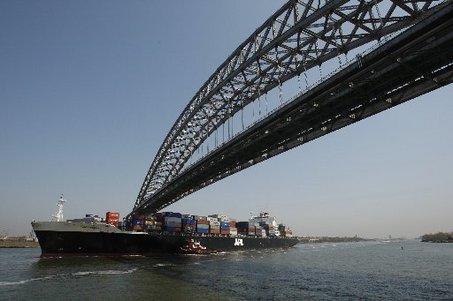
The Port of New York and New Jersey have recently announced that the raising or replacing of the Bayonne Bridge could be upwards of $2B. The bridge, which stands 151 ft over the Kill Van Kull at its highest point, is too low for the next generation of massive container ships. The bridge is the largest obstacle facing growth in the port. Traffic World Online tells us:
Richard Larrabee, the port authority’s port commerce director, spoke Monday at the bistate port’s 8th Annual Port Industry Day. Earlier estimates had been that the project would cost about $1 billion.
“The Bayonne Bridge is the Number One issue in the port,” Larrabee said. The authority expects to complete a study by next summer on how to replace or raise the bridge, which crosses the channel to container terminals in the Port Newark-Elizabeth complex in New Jersey and New York Container Terminal on Staten Island.
The Port Authority is currently in the midst of a study to decide what is the most efficient way to solve this problem, whether it is raising the height or replacing the bridge, or or building a tunnel under the Kill Van Kull.
The Bayonne Bridge, at 8640 ft, is currently the third longest steel arch bridge in the world and was the longest when it was completed in 1931. Built by the Port Authority of New York, it was constructed to allow vehicle traffic from Staten Island to reach Manhattan via the Holland Tunnel.
Related Posts:
Tags: · bridge, bridge span, design, engineering, new york

MarineBuzz points us to Norway’s plan to build a One Nautical Mile long tunnel for ships. Reuters tells us:
Norway has drawn up plans to build the world’s first shipping tunnel which would save time and money for vessels passing through a coastal area known for its dangerous seas.
Strong winds, high waves and powerful currents in the area of Stad on the southwest coast of Norway cause long delays while ships wait for calmer conditions.
The tunnel, estimated to cost around $310 million and take five years to build, would cut through a peninsula, saving ships the risky journey around the coastline. Continue Reading…
While the concept isn’t new, France has been building tunnels for barges since the 19th century, this is the first tunnel of it’s size. Head over to Marine Buzz for more photos and information.
Related Posts:
Tags: · Bridges, engineering, Interesting, marine-engineering

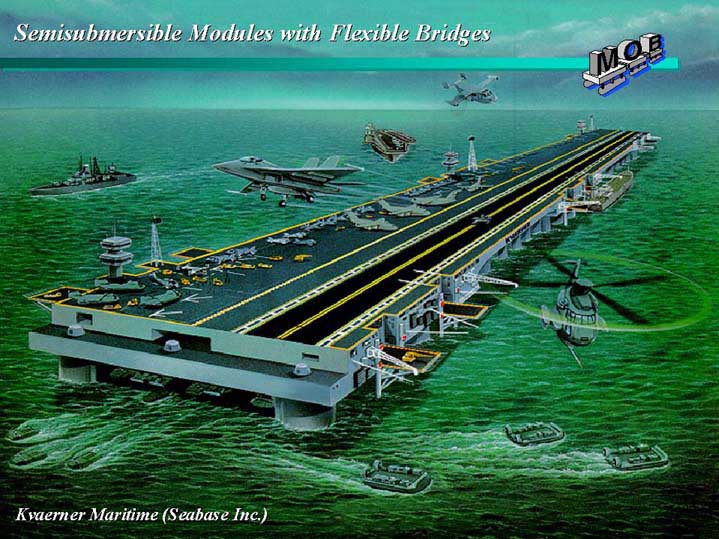
A Mobile Offshore Base (MOB), in theory, is a number of independently propelled semisubmersible modules that can be easily deployed to areas in need of military assistance. It’s primary functions would be providing a landing platform for fixed and rotary wing aircraft and stowage and transport of military cargo and personnel. The size of the base would be virtually unlimited since each module is completely self-sustaining with personnel housing, equipment maintenance functions, cargo space, and logistical support. An full MOB platform could range from a single module to a number of them. GlobalSecurity.org tells us about the assembly:
Each module consists of a box-type deck supported by multiple columns on two parallel pontoons. When transiting between operational sites, the module is deballasted and travels with the pontoons on the surface much like a catamaran. When on site, the module is ballasted down so that the pontoons are submerged below the surface wave zone, thereby minimizing the wave-induced dynamic motions. The decks, which store rolling stock and dry cargo, are all located above the wave crests. The columns provide structural support and hydrostatic stability against overturning.
Well, seems like a good idea, but is it a realistic and cost effective solution? [Continue Reading →]
Related Posts:
Tags: · engineering, future, future navy, navy_ships, Ship Design
We don’t generally post press releases on the blog here, but we have been so fascinated by some of Wärtsilä’s previous work that we thought this is worth a post.
These are just a few excerpts of the September 23 press release from Wärtsilä:
Wärtsilä has received major orders for its recently established Wärtsilä Ship Design unit. The orders were received from customers in China, India and Germany. The Ship Design unit was set up following the acquisitions of the ship design companies Vik-Sandvik and Schiffko. The most recent acquisition, the Singaporean based Conan Wu & Associates will also be part of the Ship Design unit.
The orders call for Wärtsilä to design a Deepwater Engineering Survey Vessel, a Multi-Purpose Support Vessel, a Diving Support Vessel, and an Emergency Towing Vessel. Each of these contracts comes as a result of successful bids to design sophisticated tonnage.
Now let’s hear about the vessel’s.
The Deepwater Engineering Survey Vessel design is for China Oilfield Services Ltd, and represents a 4300-dwt vessel capable of drilling operating at deep water for geotechnical surveys and geophysical surveys. To date, most of China’s oil exploration has been in relatively shallow waters, but there is now a need to probe deeper. [Continue Reading →]
Related Posts:
Tags: · engineering, Salvage, Ship Design, tugs and towing, vessel, Wartsila

Gizmodo points us towards the Russian navy’s Zubr Class hovercraft. Now this is not a new design. There have been three in service with the Russian Navy since 1988, with 2 more in the Ukraine navy and even more with the Greek navy.
The vessels are designed for military transport with the capacity to carry nearly 130 tons of cargo including multiple tanks, equipment and troops with the unique ability to deploy them directly onto land. The Zubr can cruise at max speed of 60 knots for 300 miles.
Naval-technology.com tells us about its propulsion systems:
Three upright ring shrouds, housing the air propellers and standing upright at the back of the ship, give the Zubr its distinctive appearance. The four bladed propellers which are provide the ship with a top speed of 60 knots. High-temperature gas turbine engines provide the power to drive the air-cushion blowers and the air propellers. The craft has four blowers model NO-10, fitted with axial operating wheels of 2.5m diameter, to generate the air cushion. The air thrust for movement is powered by three four-bladed, reversible, variable-pitch air propellers, 5.5m in diameter. The air propellers are mounted inside ring shrouds. The Zubr is equipped with two electric power plants. Each power plant has two gas turbine generators, each rated at 100kW. Control of the ship and systems is carried out from a main control station, a central control room and through various remote control panels.
Now let’s take a look at this thing in action.
Note: The Bora is larger, but not considered a true hovercraft since its side structure reaches the water.
Related Posts:
Tags: · engineering, Interesting, Navy, russia, vessel

The Maeslant Storm Surge Barrier is one of the largest moving structures on the planet. The barrier, completed in May of 1997, was the final stage of the Delta Works, a series of dams, sluices and storm surge barriers aimed to protect the port of Rotterdam and surrounding communities from flooding. The Delta Works was originally started following the North Sea flood of 1953 that killed over 1,800 people.
The barrier consists of two large steel gates that operate on ball-and-socket joints, much like the human shoulder, that move freely with rising water, wind and waves. The gates then close automatically by a computer system that makes the decision based on water levels and weather forecasts, with no human interaction needed.
Deltaworks.org explains its functioning:
During water levels of 3 metres above Amsterdam ordnance zero, the arms of the barrier are activated. The waterway, with a width of 360 metres, can then be closed completely. At first sight, it is almost unbelievable that such a barrier is capable of such an achievement. The Maeslant barrier is almost as long as the Eiffel tower and weighs about four times as much. It is the only storm surge barrier in the world with such large moveable parts. The storm surging doors have a length of 240 metres each. Under normal circumstances, these doors are fully opened, so that the ships have access to the port of Rotterdam. The doors are stored in docks with a length of 210 metres, which lie along both shores. [Continue Reading →]
Related Posts:
Tags: · engineering, Rotterdam, safety