Maritime Academy - Cadet Shipping

Published: June 21st, 2008 by john.denham | Comments |


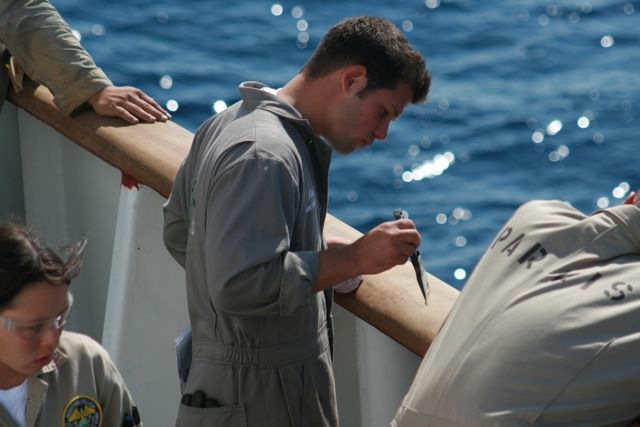
Cadet Shipping - Suny MaritimeCadet Edward Pollard on the TSES

Recent news article claim steps in obtaining agreements in placing maritime academy school students aboard merchant ships for accomplishing sea time requirements (Cadet Shipping). A step that appears to solve a problem. Getting places to stash the boys and girls seems like a good idea, but what does it actually achieve and at what cost?

License requirements requires sea time that allegedly acquaints one with the performance of seaman type works and shipboard practices. A candidate for a license should be a competent mariner (Deck or Engine qualified). The latest version of the Merchant Marine Officer’s Handbook, 5th edition, implies a newly licensed officer should “hit the deck running.” A perusal of the American Merchant Seaman’s Manual, 6th edition, list twenty three or more chapters of basic material a competent mariner should be “knowledgeable ” or at least aware of.

Taking the sample examination questions from the USCG Proceedings, Spring 2008, both deck and engine I was hard pressed to locate answers or information that would provide acceptable answers. The same applied to the two previous issues. Therefore, either the examinations are based on data that is not readily available or there is a gross deficiency in training manuals; in any case what does one study at sea, examination prep- sheets?

Of greatest concern is the lack of awareness by bureaucrats that putting kids to sea does not make them seaman. How many ship’s officers are qualified teachers , practiced instructors, good parents? The wrong experience can set a pattern that can be perpetuated for years. Cramming for an examination does not produce competency.

It is time to examine the school of the ship and resolve the requirements for education, knowledge, skill and leadership and invest our maritime training funds in those that will properly crew, operate and command the sophisticated giants of the seas in the future. Not all will be effective and efficient masters or chief engineers, but everyone licensed or documented should be competent. The expeditious path of “pumping out” licensed people to fill vacant slots is accomplishing only one purpose, increasing accidents. -JGD

John Denham is a retired USN Captain, Licensed unlimited Master and Pilot, maritime academy teacher,and author with extensive experience as a marine consultant. He is also author of The Assistant and DD 891.

Related Articles

Related Link: USCG Talk - Chat with other Guardians on our forum!

Categories: Training

Tags: · , ,


-

  • nika
    hi my neim is nick i whant tu lern in your meritime militari aqademi. now i lern in batumi steit meritime aqademi. please reqomedeit my whow tu pass examen in your aqademi. i will weit your ansver.
  • Peter,

    I whitnessed an ensign try that with a Master Chief once. I must say he was very nice in his refusal!
  • CAPT. D. Peter Boucher, MN(Ret
    eed. Imagine how it feels when some snotty nosed Ensign just out of the USCG Academy starts instructing a cruise ship Master with 45 years seatime of which 25 was in command.
    Nearly strangled the little twerp, fortunately a more senior officer came and apoligized.
    Good Watch
  • Kp graduate
    What continues to amaze me is that the USCG and other public vessels are exempt from the STCW training standards. We all sail on the same oceans, but apprently have different standards. Part of the reason the USCG credability among professional mariners continues to drop is USCG officers and petty officers are trained to sub-standard condtions. Then they are the agency charged to carry out regulations over those held to a higher standard, but yet fail to meet the same standard.
  • CAPT. D. Peter Boucher, MN(Ret
    This is hardly a new or unproven method of training. My own experience was as a British Merchant Navy Deck Apprentice. After three months shore training I joined my first ship just 3 days after my 17th. Birthday. Indentures with the Company were co-signed by my Father and were for 4 years, 1954 to 1958, at sea. During my last year I was promoted to 4th. Officer and stood watch with the Chief Officer. Then I was promoted to Third Officer on one of the smaller tonnage ships where I stood watch as OOW. We Apprentices worked under the Bosun to learn all deck work from experienced seaman. We stood Bridge & cargo watches, day & night, steering, kept lookout thus understudying the OOW. The result was that I thoroughly knew all deck, cargo and Bridge work. When it came to giving orders I knew from personal experience just what was required of each job and how long it took. Thus I always had the respect of my crews. They knew I knew my job and did not give them ridiculus orders. Finally I retired some 50 years later as Foreign-going Master. I am still active Maritime Consulting, teaching BSA Sea Scouts, writing and guest speaking. It might be fair to conclude that my training was very good and I applied it well. The judgement is yours. Good Watch
blog comments powered by Disqus


Search This Blog


Prefer Google? Click HERE


Subscribe Via Email

Daily Updates


Bi-Weekly Newsletter


Browse Categories


Authors


Recent Comments


Tags


Twitter License Plate