(Bloomberg) — Japan and India, Asia’s biggest energy consumers after China, are closer to unlocking natural gas deposits trapped in ice below the seabed that may prove bigger than the world’s known fossil-fuel reserves.
Japan Oil, Gas & Metals National Corp. said Tuesday it produced gas in the world’s first offshore test to extract the fuel from the frozen depths. A team including Oil & Natural Gas Corp., India’s biggest energy explorer, will drill off the east coast this year and try to produce the fuel, according to two officials at the regulator Directorate General of Hydrocarbons. They asked to not be named before the official announcement.
The nations are trying to catch up with North America, where discoveries of gas in shale rock and tar sands heralds an energy revolution carrying the U.S. and Canada toward energy independence. While shale is found in only certain parts of the globe, carbon frozen with water — called methane hydrates or burnable ice — is found under most sea beds. The catch: There’s no technology yet to commercially extract that gas.
“Methane hydrates are everywhere, including in some of the fastest-growing economies,” said Will Pearson, director for global energy & natural resources at Eurasia Group in London. “If the technology is developed, it’ll alter the gas market. What is already the golden age of gas will last much longer.”
Natural gas, the fuel burned to make heat and electricity, is predominantly methane. A methane hydrate is a crystal of methane molecules surrounded by a cage of water molecules, according to the U.S. Geological Survey.
Methane hydrates, stable under low temperatures and high pressure, can disintegrate when removed from those conditions.
Double Size
Initial estimates suggest carbon deposits in hydrates are double the size of all known oil, gas and coal reserves, the U.S. Geological Survey said in a January 2013 report. The world’s proven reserves of natural gas alone was 208.4 trillion cubic meters at the end of 2011, according to BP Plc.
Carbon molecules locked in ice have also been found in the North American permafrost and the Gulf of Mexico.
India is drilling for frozen gas it has preliminarily estimated to be as large as 1,894 trillion cubic meters, according to the website of the Directorate General of Hydrocarbons, the oil and gas exploration and production regulator. Japan’s deposits of frozen gas may be large enough to supply its needs for about 100 years, according to Japan Oil, Gas & Minerals, a government-affiliate known as Jogmec.
“Methane hydrate could give Japan its own energy source and more independence,” said Tomoo Suzuki, professor emeritus at Tokyo Institute of Technology, who leads a study on methane hydrate deposits off the coast of Kochi prefecture. “The question is whether extracting gas from methane hydrate can be economically viable.”
Bay of Bengal
India, which discovered methane hydrates in the Bay of Bengal off its east coast, will later this year drill a few wells and engage in some test production to determine the size of the resource, a person familiar with the program said. Scientists have also found traces of conventional gas under the layer of hydrates on the ocean floor, the person said.
Oil & Natural Gas Chairman Sudhir Vasudeva didn’t answer calls to his telephone seeking comment on the company’s plan to extract methane from hydrates.
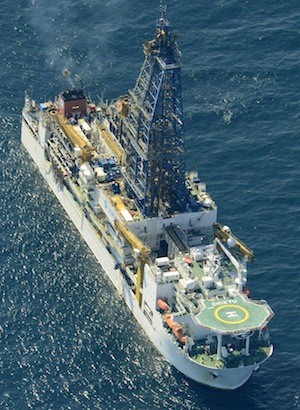
In Japan’s test phase, gas was produced in the Nankai Trough about 50 kilometers (31 miles) off the coast of the country’s main Honshu island, Jogmec said.
The Eastern Nankai Trough deposits may hold the equivalent of about 40 trillion cubic feet of methane, a primary element of natural gas, according to the statement. That’s equivalent to about 11 years of Japan’s LNG imports, it said.
Commercial Use
The country is trying to to enable commercial use by fiscal 2018, according to Jogmec. Japan used a depressurization method in its latest test, a technology that was used when Japan and Canada jointly conducted a test production in the permafrost of northern Canada in 2008. That was the world’s first continuous and stable production from frozen gas sediments, according to the company.
The success of the offshore test doesn’t guarantee commercialization because of the short time span of production, said Yuji Morita, a senior researcher at Japan’s Institute of Energy Economics. The production cost won’t be an issue in the run-up to the commercialization of the fuel, Morita said.
“Hydrates store immense amounts of methane, with major implications for energy resources and climate, but the natural controls on hydrates and their impacts on the environment are very poorly understood,” the U.S. Geological Survey said in its January report. “Extraction of methane from hydrates could provide an enormous energy and petroleum feedstock resource.”
Global Warming
Explorers must find a way to avoid releasing large quantities of methane from hydrates into the air and the ocean. Methane traps heat so effectively it is about 10 times more potent than carbon dioxide as a greenhouse gas, according to the agency. Ice melts can reduce the pressure on the hydrates, resulting in the gas leaking out.
A study in the journal Nature in December 2011 found thawing of permafrost may release the equivalent of 380 billion tons of carbon dioxide this century if the Arctic warms by 7.5 degrees Celsius (13.5 degrees Fahrenheit). That includes large quantities of methane, which may increase temperatures.
Nations around the world are seeking new energy sources as demand increases. China, the world’s biggest energy consumer, is looking for technology to produce from the world’s biggest estimated shale gas deposit and enhance output from coal seams.
While India imports more than 75 percent of its crude oil and a quarter of its natural gas requirements, Japan buys all its oil and gas from overseas and is seeking to find ways to cut its dependence on Middle Eastern crude oil.
“Countries that highlight the opportunity are those with limited oil and gas production,” said Nathan Piper, an Edinburgh-based analyst at RBC Capital Markets. “Gas hydrates remain challenging due in part to the offshore location.”
Copyright 2013 Bloomberg.

 Join The Club