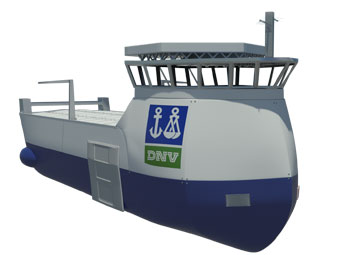
The Boreast, multifunctional concept vessel and cornerstone of the AURORA system. Image: DNV
DNV’s summer students this week presented the results of seven weeks of intense and targeted work to develop a realistic and suitable concept for a year-round Arctic oil spill response system, including requirements for people, vessels and equipment.
The summer project is one of DNV’s an annual programs organized for students in their final year of a master’s degree program. This year, ten students with varied cultural and academic backgrounds spent seven intense weeks developing the AURORA, a practical response system for potential future use in the arctic.
“We know that the world needs more energy. And we know that much of this energy is located in unfriendly and vulnerable areas of the world. Adequate oil spill response systems are therefore of vital importance. These are complex issues that the world’s leading scientists, researchers and engineers spend considerable time and resources on. So I am impressed by what these ten students have been able to process and produce during seven short summer weeks,” says DNV’s CEO Henrik O. Madsen.
Realistic and innovative
Research shows that about 22–25% of the world’s undiscovered petroleum resources are located in the Arctic. However, there are many complex challenges related to drilling in this region. One of these is to have a system in place should an accident occur. “We presented a realistic, innovative Arctic oil spill response system we have called the AURORA –Arctic United Response Operation and Recovery Agreement – combining new ideas and fresh insight,” explains project manager Martin Andestad. The main purpose of an oil spill response system is to limit the consequences of an oil spill, and the methods are divided into three categories; mechanical recovery, non-mechanical recovery and manual recovery.
Three oil spill response levels
The AURORA is divided into three oil spill response levels. The first response is conducted by on-site vessels. The second is conducted by vessels arriving from the closest cold or warm hub. The third, which includes beach clean-up, is a large mobilisation by all hubs. The hub locations are chosen based on the existing infrastructure along the Northern Sea Route. Warm hubs contain all the equipment included in the AURORA, while cold hubs function as extensions of the warm hubs.
Multifunctional concept vessel
The AURORA’s cornerstone is a multifunctional concept vessel – the Boreast – capable of performing oil spill response tasks in the Arctic. This vessel has a number of innovative solutions on board; an unmanned aerial vehicle, remote in-situ burning, an autonomous underwater vehicle, towable storage bladders and an ice cleaning conveyor belt to mention a few. The AURORA further combines efficient logistics, appropriate vessels, a wide range of equipment and human expertise to create an oil spill response system with high performance and low cost. The students presented the concept in two scenarios; a drilling rig blow-out and a cargo ship grounding. But as they said: “The AURORA states a high level of preparation, but this might not be enough to ensure safe operations in the future. In the Arctic, there is no room for a weak link.”
Unlock Exclusive Insights Today!
Join the gCaptain Club for curated content, insider opinions, and vibrant community discussions.

 Join The Club