US Coast Guard Photo
By Jef Feeley and Allen Johnson Jr.
(Bloomberg) — BP Plc, Transocean Ltd. and Halliburton Co. are seeking to avoid billions of dollars in damages by proving in court that mistakes leading to the 2010 Gulf of Mexico oil spilldidn’t amount to gross negligence.
Opening statements began this morning in New Orleans before U.S. District Judge Carl Barbier, who will weigh the evidence without a jury, to determine fault and whether one or more of the companies acted with willful or wanton misconduct or reckless indifference — the legal requirement for establishing gross negligence.
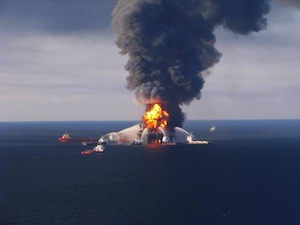
The blowout and explosion aboard the Deepwater Horizon drilling rig killed 11 workers and spilled more than 4 million barrels of oil into the Gulf. The accident sparked hundreds of lawsuits against London-based BP, Vernier, Switzerland-based Transocean, owner of the rig, and Houston-based Halliburton, which provided cement for the well.
One reason for the disaster was the “willful failure of Transocean to give its Deepwater Horizon crew adequate training” on how to interpret safety tests on the well, Jim Roy, a lawyer for oil-spillvictims, told Barbier in his opening statement. “The gross and extreme departure from good oil-field practice rests with the management of Transocean,” Roy said.
Punitive Damages
BP executives’ “missteps and reckless decisions” in connection with the Macondo well led to the explosion that killed 11 workers and sent millions of gallons of oil spewing into the Gulf, Michael Underhill, a U.S. Justice Department lawyer, told Barbier. “BP put profits before people, profits before safety and profits before the environment,” he said.
For BP, owner of the Macondo well that blew up in the Gulf, a finding of gross negligence would mean the company is liable to the U.S. for as much as $17.6 billion in Clean Water Act fines, as well as unspecified punitive damages to claimants who weren’t part of the $8.5 billion settlement the company reached last year. For Transocean and Halliburton, a finding of gross negligence would mean the companies can be held liable for punitive damages for all plaintiffs.
BP, over-budget and behind schedule for the Macondo well, cut corners and ignored tests showing unsafe pressure levels as it tried to complete the project, Roy said today. Spill victims also contend that Halliburton’s cement job was defective and that Transocean disabled safety systems and failed to maintain the rig and adequately train its crew.
Maritime Law
BP sued its contractors, claiming Transocean failed to maintain the drilling rig and Halliburton provided defective cementing services and concealed problems with the cement before and after the explosion. Transocean and Halliburton pointed fingers back at BP.
Barbier will apply maritime law, which governs this phase of the litigation. A trial on efforts to contain the spill is set for September. One or more trials on damages will follow, barring any out-of-court settlements.
The judge will apportion fault for the explosion and spill among BP and its subcontractors. Halliburton and Transocean would only be responsible for punitive damages, based on Barbier’s ruling last year that the project contract required BP to indemnify them for compensatory damages.
BP is responsible for any compensatory damages awarded to plaintiffs who haven’t previously settled. Those plaintiffs, including businesses such as banks and casinos and those harmed by the deep-water drilling moratorium imposed by the U.S. after the spill, are also seeking punitive damages. BP has said it will fight these claims.
Safety Tests
BP officials failed to properly interpret safety tests showing the Macondo well was unstable and failed to shut down the drilling platform even though months before they’d been made aware of problems with the vessel, Underhill said in his opening statement.
BP officials knew HAL’s cement job on the rig was substandard, but executives didn’t want to delay drilling operations to fix it, the Justice Department lawyer said. “Who cares, it’s done, end of story,” Brett Cocales, a BP engineer responded in an e-mail to concerns about the cement.
BP had a “corporate culture that disregarded safety” issues and that led to disaster on the rig, Underhill said. “The primary fault for this disaster lies with BP.”
Luther Strange, Alabama’s attorney general, told the judge today that BP put profit ahead of safety and that led to the Deepwater Horizon disaster.
‘Money Mattered’
“BP was blinded by their bottom line,” Strange said. “Money mattered more than the environment, it mattered more than the jobs destroyed and the lives of workers on the rig. Greed devastated the Gulf.”
Transocean officials’ push to maximize profits off the Deepwater Horizon rig meant the company had never called the vessel back to port for maintenance in its nine-year career, Roy said. BP officials had found more than 390 maintenance problems with DWH that would have required more than 3,000 hours to correct, the lawyer for spill victims added.
Transocean adopted a “run it till it breaks philosophy” and that led to repeated equipment failures on the Deepwater Horizon rig that were left unaddressed, he added. Those failures included the so-called blowout preventer, a safety device designed to stop explosions. Transocean officials knew they were required to maintain the device and failed to do so, Roy added.
Safety Issues
Still, the 400-ton blowout-prevention system, built by Houston-based Cameron International Corp., was defectively designed and Cameron officials knew it wouldn’t work properly in the event of a disaster, Roy added.
A Transocean official acknowledged in a 2009 document the driller often focused so much on “saving money in the short term” that it affected maintenance and safety issues, Roy said.
Brad Brian, one of Transocean’s lawyers, countered in his opening statement that the drilling firm properly trained the Deepwater Horizon crew in safety procedures and the rig wasn’t neglected by the company.
Transocean’s training program met the standards set by the oil industry, Brian said. Every company “can do better” on training, but Transocean didn’t ignore the need to have drilling crews exposed to rig-safety instruction, he added.
‘Excellent Condition’
The Deepwater Horizon was “one of the best rigs in the world,” Brian said. It was inspected hundreds of times by government officials and found to be in proper operating condition. For example, the U.S. Coast Guard certified the rig as being in “excellent condition” in 2009, he said.
“The problem here wasn’t with the rig or the crew,” Brian said. “The problem was the well and how BP managed it.”
The trial, initially set to begin last March, was rescheduled after BP reached a settlement with most individual and other so-called private-party plaintiffs.
That settlement, which isn’t capped, is estimated at $8.5 billion by BP and excludes claims of financial institutions, casinos, private plaintiffs in parts of Florida and Texas, and residents and businesses alleging harm from the deep-water drilling moratorium.
It also didn’t cover federal government claims and those of Gulf Coast states Louisiana and Alabama, or lawsuits against co- defendants. Lawyers for the U.S. and the two states will be presenting evidence at the trial, along with attorneys for the private parties. BP has said the states are claiming at least $34 billion in damages.
Cleanup Costs
The U.S. government sued BP and Transocean in 2010 for violations of the Clean Water Act and the Oil Pollution Act, seeking fines, cleanup costs and natural-resources damages.
The U.S. estimated that 4.9 million barrels gushed from the doomed Macondo well. BP and the government agreed last week that 810,000 barrels of oil that the company captured before they entered Gulf waters wouldn’t be included in Clean Water Act fine calculations. The agreement cut BP’s highest potential government fine by $3.4 billion.
The case is In re Oil Spill by the Oil Rig Deepwater Horizon in the Gulf of Mexico on April 20, 2010, MDL-2179, U.S. District Court, Eastern District of Louisiana (New Orleans).
Copyright 2013 Bloomberg.
Unlock Exclusive Insights Today!
Join the gCaptain Club for curated content, insider opinions, and vibrant community discussions.

 Join The Club